Responding to a Ransomware Attack: Clean Recovery Options are Critical
Author
Naj Husain
Date Published

Najaf Husain, CEO
Ransomware attacks have become an ever-present threat to organizations of all sizes and industries. These malicious attacks can wreak havoc on a company's operations, causing significant financial and reputational damage. To combat this growing menace, it's crucial for businesses to have a well-thought-out ransomware response plan in place.
Preparing for a Ransomware Attack
The significance of having well-established, clean, and uncompromised recovery options cannot be overstated. Even with leading Extended Detection and Response (XDR) solutions, breaches can still occur, as evidenced by notable incidents like the attack on the City of Dallas, which showcased the persistence of attackers within networks despite robust defenses. Once these infiltrators gain access, they can target data stored on Elastic Block Storage (EBS) volumes or delete objects in Amazon S3, effectively holding them hostage for ransom, similar to what they would do with a Virtual Machine.
The Importance of Verified Clean Recovery Options
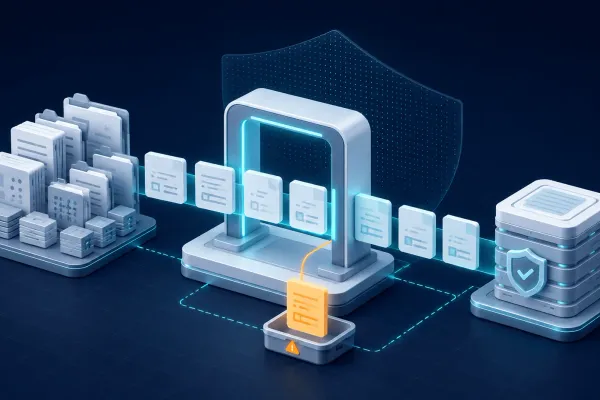
Elastio steps in to provide a solution. It offers the capability to create data snapshots, archiving them in a globally deduplicated and compressed format within S3 inside your account. We call this the Elastio Cyber Vault. Snapshots ingested into the vault undergo a thorough file inspection, scanning for over 2200 ransomware families and thousands of variants to ensure the data remains clean, uncompromised, and recoverable. If any active ransomware or malware is detected, specific files are promptly identified and sent to a Security Information and Event Management (SIEM) system. Elastio's incident response team takes it from there, analyzing the alerts and confirming the findings. The Vault itself is protected by S3 Object Lock to ensure that even admin-level IAM credentials are incapable of destroying it.
Elastio also offers multiple recovery options, ranging from restoring to a known clean recovery point, enabling file-level recoveries, as well as EC2 and EBS recoveries. For infected assets, there's an option to recover them in an isolated sandbox environment. When it comes to production workloads, the Elastio live recovery option stands out by providing a rapid Recovery Time Objective (RTO) in a matter of minutes from the last known clean recovery point.
To further fortify security and ensure a robust response plan, Elastio continuously snapshots the data, archives it, and checks its data integrity. This ongoing process not only enhances security but also acts as the ultimate safeguard, serving as the last line of defense in a comprehensive security strategy.
The Last Line of Defense
In essence, ransomware attacks are a numbers game involving a constant barrage of attempts until one inevitably breaches the defenses. This highlights the necessity of having a robust response plan that includes clean and uncompromised backups, such as those offered by Elastio, to ensure that even if an attack occurs, your organization can swiftly recover without paying the ransom.
How Elastio Helps
Elastio's data resilience platform ensures that your live data and backups are clean, uncompromised, and recoverable from ransomware attacks.
Elastio reverse-engineered over 2200 ransomware families and developed the most comprehensive ransomware detection engine capable of pinpointing ransomware down to individual variants and files. Our advanced behavioral analytics model thoroughly examines your data for ransomware, malware, and corruption, providing the means for a secure recovery through point-in-time restoration of applications and data to a verified clean copy.
With a proven track record of tens of billions of ransomware scans, our agentless platform empowers customers to validate the integrity of their live data and backups across AWS, Azure, and VMware. This includes securing critical areas of enterprise risk — core workloads, production databases, and object storage, ensuring that your data remains clean, uncompromised, and recoverable.
Recover With Certainty
See how Elastio validates every backup across clouds and platforms to recover faster, cut downtime by 90%, and achieve 25x ROI.
Related Articles

Cloud ransomware incidents rarely begin with visible disruption. More often, they unfold quietly, long before an alert is triggered or a system fails. By the time incident response teams are engaged, organizations have usually already taken decisive action. Workloads are isolated. Instances are terminated. Cloud dashboards show unusual activity. Executives, legal counsel, and communications teams are already involved. And very quickly, one question dominates every discussion. What can we restore that we actually trust? That question exposes a critical gap in many cloud-native resilience strategies. Most organizations have backups. Many have immutable storage, cross-region replication, and locked vaults. These controls are aligned with cloud provider best practices and availability frameworks. Yet during ransomware recovery, those same organizations often cannot confidently determine which recovery point is clean. Cloud doesn’t remove ransomware risk — it relocates it This is not a failure of effort. It is a consequence of how cloud architectures shift risk. Cloud-native environments have dramatically improved the security posture of compute. Infrastructure is ephemeral. Servers are no longer repaired; they are replaced. Containers and instances are designed to be disposable. From a defensive standpoint, this reduces persistence at the infrastructure layer and limits traditional malware dwell time. However, cloud migration does not remove ransomware risk. It relocates it. Persistent storage remains long-lived, highly automated, and deeply trusted. Object stores, block snapshots, backups, and replicas are designed to survive everything else. Modern ransomware campaigns increasingly target this persistence layer, not the compute that accesses it. Attackers don’t need malware — they need credentials Industry investigations consistently support this pattern. Mandiant, Verizon DBIR, and other threat intelligence sources report that credential compromise and identity abuse are now among the most common initial access vectors in cloud incidents. Once attackers obtain valid credentials, they can operate entirely through native cloud APIs, often without deploying custom malware or triggering endpoint-based detections. From an operational standpoint, these actions appear legitimate. Data is written, versions are created, snapshots are taken, and replication occurs as designed. The cloud platform faithfully records and preserves state, regardless of whether that state is healthy or compromised. This is where many organizations encounter an uncomfortable reality during incident response. Immutability is not integrity Immutability ensures that data cannot be deleted or altered after it is written. It does not validate whether the data was already encrypted, corrupted, or poisoned at the time it was captured. Cloud-native durability and availability controls were never designed to answer the question incident responders care about most: whether stored data can be trusted for recovery. In ransomware cases, incident response teams repeatedly observe the same failure mode. Attackers encrypt or corrupt production data, often gradually, using authorized access. Automated backup systems snapshot that corrupted state. Replication propagates it to secondary regions. Vault locks seal it permanently. The organization has not lost its backups. It has preserved the compromised data exactly as designed. Backup isolation alone is not enough This dynamic is particularly dangerous in cloud environments because it can occur without malware, without infrastructure compromise, and without violating immutability controls. CISA and NIST have both explicitly warned that backup isolation and retention alone are insufficient if integrity is not verified. Availability testing does not guarantee recoverability. Replication can accelerate the blast radius Replication further amplifies the impact. Cross-region architectures prioritize recovery point objectives and automation speed. When data changes in a primary region, those changes are immediately propagated to disaster recovery environments. If the change is ransomware-induced corruption, replication accelerates the blast radius rather than containing it. From the incident response perspective, this creates a critical bottleneck that is often misunderstood. The hardest part of recovery is deciding what to restore The hardest part of recovery is not rebuilding infrastructure. Cloud platforms make redeployment fast and repeatable. Entire environments can be recreated in hours. The hardest part is deciding what to restore. Without integrity validation, teams are forced into manual forensic processes under extreme pressure. Snapshots are mounted one by one. Logs are reviewed. Timelines are debated. Restore attempts become experiments. Every decision carries risk, and every delay compounds business impact. This is why ransomware recovery frequently takes days or weeks even when backups exist. Boards don’t ask “Do we have backups?” Boards do not ask whether backups are available. They ask which recovery point is the last known clean state. Without objective integrity assurance, that question cannot be answered deterministically. This uncertainty is not incidental. It is central to how modern ransomware creates leverage. Attackers understand that corrupting trust in recovery systems can be as effective as destroying systems outright. What incident response teams wish you had is certainty What incident response teams consistently wish organizations had before an incident is not more backups, but more certainty. The ability to prove, not assume, that recovery data is clean. Evidence that restoration decisions are based on validated integrity rather than best guesses made under pressure. Integrity assurance is the missing control This is where integrity assurance becomes the missing control in many cloud strategies. NIST CSF explicitly calls for verification of backup integrity as part of the Recover function. Yet most cloud-native architectures stop at durability and immutability. When integrity validation is in place, recovery changes fundamentally. Organizations can identify the last known clean recovery point ahead of time. Recovery decisions become faster, safer, and defensible. Executive and regulatory confidence improves because actions are supported by evidence. From an incident response standpoint, the difference is stark. One scenario is prolonged uncertainty and escalating risk. The other is controlled, confident recovery. Resilience is proving trust, not storing data Cloud-native architecture is powerful, but ransomware has adapted to it. In today’s threat landscape, resilience is no longer defined by whether data exists somewhere in the cloud. It is defined by whether an organization can prove that the data it restores is trustworthy. That is what incident response teams see after cloud ransomware. Not missing backups, but missing certainty. Certainty is the foundation of recovery And in modern cloud environments, certainty is the foundation of recovery.

CMORG’s Data Vaulting Guidance: Integrity Validation Is Now a Core Requirement In January 2025, the Cross Market Operational Resilience Group (CMORG) published Cloud-Hosted Data Vaulting: Good Practice Guidance. It is a timely and important contribution to the operational resilience of the UK financial sector. CMORG deserves recognition for treating recovery architecture as a priority, not a future initiative. In financial services, the consequences of a cyber event extend well beyond a single institution. When critical systems are disrupted and recovery fails, the impact can cascade across customers, counterparties, and markets. The broader issue is confidence. A high-profile failure to recover can create damage that reaches far beyond the affected firm. This is why CMORG’s cross-industry collaboration matters. It reflects an understanding that resilience is a shared responsibility. Important Theme: Integrity Validation The guidance does a strong job outlining the principles of cloud-hosted vaulting, including isolation, immutability, access control, and key management. These are necessary design elements for protecting recovery data against compromise. But a highly significant element of the document is its emphasis on integrity validation as a core requirement. CMORG Foundation Principle #11 states: “The data vault solution must have the ability to run analytics against its objects to check integrity and for any anomalies without executing the object. Integrity checks must be done prior to securing the data, doing it post will not ensure recovery of the original data or the service that the data supported.” This is a critical point. Immutability can prevent changes after data is stored, but it cannot ensure that the data was clean and recoverable at the time it was vaulted. If compromised data is written into an immutable environment, it becomes a permanently protected failure point. Integrity validation must occur before data becomes the organization’s final recovery source of truth. CMORG Directly Addresses the Risk of Vaulting Corrupted Data CMORG reinforces this reality in Annex A, Use Case #2, which addresses data corruption events: “For this use case when data is ‘damaged’ or has been manipulated having the data vaulted would not help, since the vaulted data would have backed up the ‘damaged’ data. This is where one would need error detection and data integrity checks either via the application or via the backup product.” This is one of the most important observations in the document. Vaulting can provide secure retention and isolation, but it cannot determine whether the data entering the vault is trustworthy. Without integrity controls, vaulting can unintentionally preserve compromised recovery points. The Threat Model Has Changed The guidance aligns with what many organizations are experiencing in practice. Cyber-attacks are no longer limited to fast encryption events. Attackers increasingly focus on compromising recovery, degrading integrity over time, and targeting backups and recovery infrastructure. These attacks may involve selective encryption, gradual corruption, manipulation of critical datasets, or compromise of backup management systems prior to detonation. In many cases, the goal is to eliminate confidence in restoration and increase leverage during extortion. The longer these attacks go undetected, the more likely compromised data is replicated across snapshots, backups, vaults, and long-term retention copies. At that point, recovery becomes uncertain and time-consuming, even if recovery infrastructure remains available. Why Integrity Scanning Must Happen Before Data Is Secured CMORG’s point about validating integrity before data is secured is particularly important. Detection timing directly affects recovery outcomes. Early detection preserves clean recovery points and reduces the scope of failed recovery points. Late detection increases the likelihood that all available recovery copies contain the same corruption or compromise. This is why Elastio’s approach is focused on integrity validation of data before it becomes the foundation of recovery. Organizations need a way to identify ransomware encryption patterns and corruption within data early for recovery to be predictable and defensible. A Meaningful Step Forward for the Industry CMORG’s cloud-hosted data vaulting guidance represents an important milestone. It reflects a mature view of resilience that recognizes vaulting and immutability as foundational, but incomplete without integrity validation. The integrity of data must be treated as a primary control. CMORG is correct to call this out. It is one of the clearest statements published by an industry body on what effective cyber vaulting must include to support real recovery.

Closing the Data Integrity Control Gap In 2025, the cybersecurity narrative shifted from protection to provable resilience. The reason? A staggering 333% surge in "Hunter-Killer" malware threats designed not just to evade your security stack, but to systematically dismantle it. For CISOs and CTOs in regulated industries, this isn't just a technical hurdle; it is a Material Risk that traditional recovery frameworks are failing to address. The Hunter-Killer Era: Blinding the Frontline The Picus Red Report 2024 identified that one out of every four malware samples now includes "Hunter-Killer" functionality. These tools, like EDRKillShifter, target the kernel-level "callbacks" that EDR and Antivirus rely on to monitor your environment. The Result: Your dashboard shows a "Green" status, while the adversary is silently corrupting your production data. This creates a Recovery Blind Spot that traditional, agent-based controls cannot see. The Material Impact: Unquantifiable Downtime When your primary defense is blinded, the "dwell time", the period an attacker sits in your network, balloons to a median of 11–26 days. In a regulated environment, this dwell time is a liability engine: The Poisoned Backup: Ransomware dwells long enough to be replicated into your "immutable" vaults.The Forensic Gridlock: Organizations spend an average of 24 days in downtime manually hunting for a "clean" recovery point.The Disclosure Clock: Under current SEC mandates, you have four days to determine the materiality of an incident. If you can’t prove your data integrity, you can’t accurately disclose your risk. Agentless Sovereignty: The Missing Control Elastio addresses the Data Integrity Gap by sitting outside the line of fire. By moving the validation layer from the compromised OS to the storage layer, we provide the only independent source of truth. The Control GapThe Elastio OutcomeAgent FragilityAgentless Sovereignty: Sitting out-of-band, Elastio is invisible to kernel-level "Hunter-Killer" malware.Trust BlindnessIndependent Truth: We validate data integrity directly from storage, ensuring recovery points are clean before you restore.Forensic LagMean Time to Clean Recovery (MTCR): Pinpoint the exact second of integrity loss to slash downtime from weeks to minutes. References & Sources GuidePoint Security GRIT 2026 Report: 58% year-over-year increase in ransomware victims.Picus Security Red Report 2024: 333% surge in Hunter-Killer malware targeting defensive systems.ESET Research - EDRKillShifter Analysis: Technical deep-dive into RansomHub’s custom EDR killer and BYOVD tactics.Mandiant M-Trends 2025: Median dwell time increases to 11 days; 57% of breaches notified by external sources.Pure Storage/Halcyon/RansomwareHelp: Average ransomware downtime recorded at 24 days across multiple industries in 2025.Cybereason True Cost to Business: 80% of organizations who pay a ransom are hit a second time.