What Is Cyberstorage? A Definition for Ransomware-Era Storage
Most storage security answers one question: who is allowed to change or delete this data? Cyberstorage answers a second one: is the data already sitting in storage clean?
In this piece, cyberstorage means storage that actively defends the data it holds. It inspects stored data for ransomware, malware, and unauthorized encryption, and it produces evidence about whether a given copy passed those checks. The term is newer than the idea, and definitions still vary by vendor.
Conventional storage security stops at access and retention: encryption at rest, role-based access, write-once-read-many locks, deletion holds. Those controls govern who can touch a copy. They say nothing about what the copy has become.
Immutability proves a copy cannot be altered. Cyberstorage checks whether the copy was already compromised when it was written.
That gap exists because attackers now target recovery data on purpose. MITRE ATT&CK tracks the behavior as Inhibit System Recovery, where adversaries delete shadow copies, disable recovery features, and remove backup catalogs, and as Data Encrypted for Impact, where they encrypt data in place to deny access. CISA’s #StopRansomware Guide tells defenders to maintain offline, encrypted, and tested backups for exactly this reason. A storage layer that cannot tell clean data from compromised data leaves that final judgment to the people standing on the recovery bridge at 3 a.m.
Three capabilities separate cyberstorage from ordinary storage:
- Detection inside the data. It examines stored content for ransomware, malware, and unauthorized or anomalous encryption, beyond access logs and integrity hashes.
- Clean-copy identification. It can point to the most recent copy with evidence that it passed ransomware, malware, and unauthorized-encryption checks.
- Restorable evidence. It records findings that a recovery team, auditor, or insurer can use to defend a restore decision.
How cyberstorage differs from immutable backup and cyber vaulting
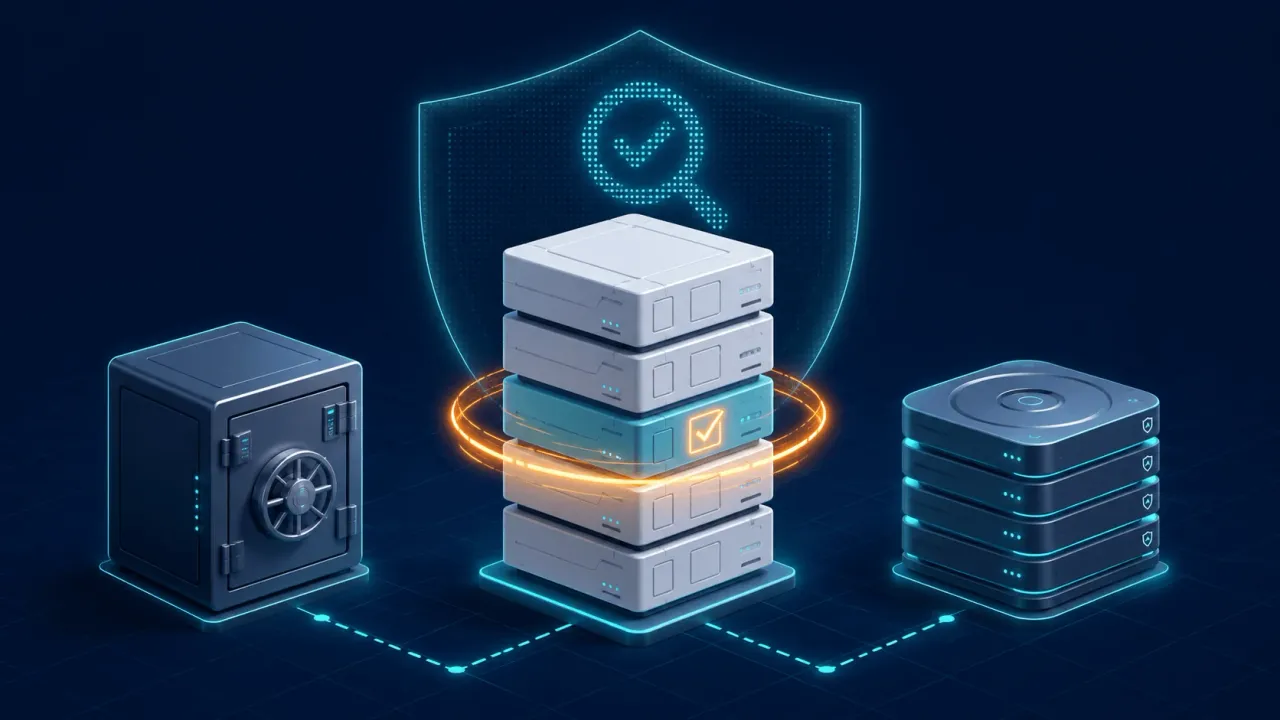
Immutable backup, cyber vaulting, and cyberstorage are often discussed as if they were the same control. They solve different parts of the problem, and a recovery program usually needs all three.
| Capability | Immutable backup / WORM | Cyber vaulting (isolated copy) | Cyberstorage |
|---|---|---|---|
| Blocks change or deletion of the copy | Yes | Yes | Yes |
| Isolates the copy from the production blast radius | Partial | Yes | Varies by deployment |
| Detects ransomware or encryption inside the stored data | No | Not by default | Yes |
| Identifies the most recent clean copy | No | Only with an added inspection layer | Yes |
| Produces evidence a copy is clean | No | Only with an added inspection layer | Yes |
Immutability is a retention control. AWS implements it through S3 Object Lock and Backup Vault Lock, which can deny deletion and lifecycle changes inside a retention window, including by privileged users. That stops an attacker from destroying the copy. It does not stop the attacker from having encrypted the data before the copy was written.
Cyber vaulting adds isolation. An isolated, immutable copy is harder for an intruder to reach, and isolated recovery copies are one recovery architecture pattern. The rise of cyber vaulting walks through that approach.
Isolation reduces the chance the copy is tampered with after the fact. It still does not inspect what is inside the copy. A vault full of clean-looking but already-encrypted recovery points is a well-protected dead end.
Cyberstorage is the inspection layer that those two controls are missing. It treats the contents of a copy as the thing to verify, rather than the perimeter around it.
Map cyberstorage against the six NIST CSF functions
The clearest way to evaluate a cyberstorage claim is to hold it against the NIST Cybersecurity Framework 2.0 and its six functions: Govern, Identify, Protect, Detect, Respond, and Recover.
Encryption, access control, and immutability live almost entirely under Protect. That is where most storage security stops, and it is why a storage estate can pass an access-control audit and still fail a ransomware recovery.
Storage earns the cyberstorage label when it also supports Detect, Respond, and Recover. Protect alone is not enough.
Detect means the storage layer can find ransomware, malware, or unauthorized encryption in the data it holds. Respond means it can separate compromised copies from clean ones and flag the difference before anyone restores. Recover means it can identify and validate a clean copy and produce the evidence behind that choice. Govern and Identify wrap the program: knowing which data matters, who owns the recovery decision, and what evidence the board and regulators expect.
Run that test against any storage or backup product. If every claim it makes falls under Protect, it is immutable storage with good marketing, not cyberstorage.
The failure mode cyberstorage is built to close
Here is the scenario that immutability and isolation alone cannot solve.
An intruder gains access and stages malware or begins low-and-slow encryption days before anyone notices. Every backup job in that window succeeds, and every copy is written to immutable, isolated storage exactly as designed, so the dashboards stay green. When detonation happens and the incident opens, the recovery team reaches for the newest recovery point.
That recovery point is immutable, isolated, and compromised, so restoring it does not bring back the business. The retention control worked; the recovery still failed, and the team burns hours testing copies one by one to find a clean one, if there even is one. This is the gap What Is Recovery Assurance? and ransomware recovery starts with a provable clean recovery point both turn on.
Closing that gap is the job of detection at the storage layer. Our Active Cyber Resilience Platform inspects backups, snapshots, and object versions for ransomware and malware, identifies the most recent recovery point confirmed clean, and tracks the distance between now and that copy as Resilience RPO. That number, not the backup schedule, is what tells a recovery team how far back it has to reach to restore with evidence.
How to evaluate a cyberstorage claim
Vendors will attach the word to products that only do retention. Five questions separate detection from packaging:
- Does it inspect the contents of stored data for ransomware and unauthorized encryption, or only verify hashes and access logs?
- Can it name the most recent recovery point with evidence it is clean, for a specific service, on demand?
- Does its detection cover the cloud-native sources you actually restore from, including snapshots, object versions, and database recovery points, rather than a single appliance?
- Does it produce findings a recovery team can act on at 3 a.m. and an auditor can read afterward?
- Does it measure recovery readiness as the age of the last clean copy, or only as backup-job success?
If the answers live in separate tools that cannot be joined by service, the storage layer is not yet doing the cyberstorage job.
Endpoint detection will not cover this gap
Existing endpoint detection is the usual reason teams assume ransomware is already handled, but it watches live systems and processes, not data at rest. It does not inspect backups, snapshots, and object stores, and attackers can disable, degrade, or tamper with the defensive tooling itself, a behavior MITRE ATT&CK catalogs as Disable or Modify Tools. The recovery data you fall back on after the endpoints are gone is exactly the data endpoint detection never examined.
Pick the ten services your business cannot run without. For each one, find the most recent copy with clean-copy evidence, the source of that evidence, and the storage layer that produced it. Bring those ten to your next Recovery Assessment and see how many have an answer.
References
[1] NIST, The NIST Cybersecurity Framework (CSF) 2.0, NIST.CSWP.29, February 26, 2024.
[2] MITRE ATT&CK, Inhibit System Recovery, T1490.
[3] MITRE ATT&CK, Data Encrypted for Impact, T1486.
[4] MITRE ATT&CK, Disable or Modify Tools, T1685.
[5] CISA, FBI, NSA, and MS-ISAC, #StopRansomware Guide, revised October 19, 2023.
[6] AWS, Using S3 Object Lock, Amazon S3 User Guide.
[7] AWS, AWS Backup Vault Lock, AWS Backup Developer Guide.
[8] Elastio, The Active Cyber Resilience Platform.