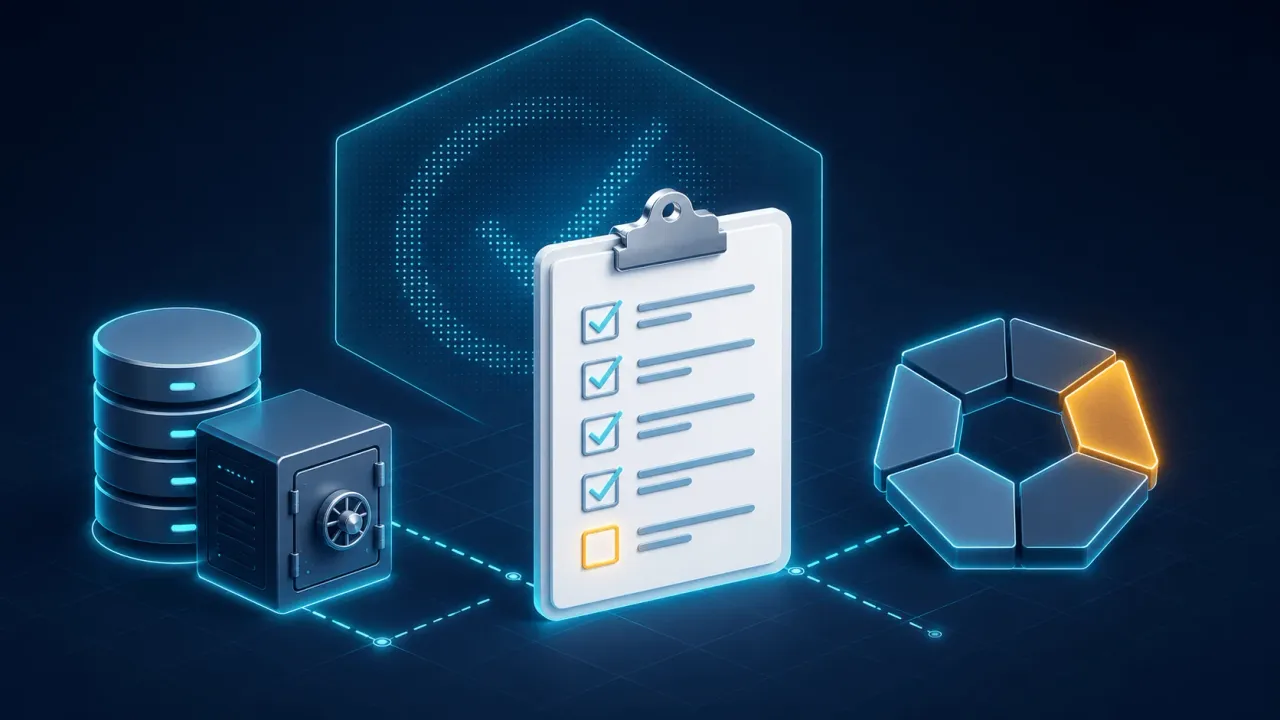
Most CSF mappings spend their budget on Protect. Firewalls, access control, encryption, and immutable storage are easy to point at and easy to audit. Ransomware is not decided there. It is decided in Detect, Respond, and Recover, and the 2024 release added Govern to put the board in the loop.
NIST CSF 2.0 is a voluntary framework, not a regulation. That is what makes it the right organizing model for this: the regulations that do carry force, from disclosure rules to sector directives, map back to these six functions. Get the framework mapping right and the compliance mappings get easier.
A ransomware program mapped to CSF 2.0 stands or falls on the RECOVER function, which is the part most organizations underbuild.
The six functions in one pass
CSF 2.0 organizes outcomes into six functions, per the NIST Cybersecurity Framework 2.0:
- Govern (GV): the risk-management strategy, expectations, and policy are set, communicated, and monitored.
- Identify (ID): the assets, data, and dependencies that matter are known.
- Protect (PR): safeguards limit the likelihood and impact of an event.
- Detect (DE): possible compromises are found.
- Respond (RS): action is taken on a detected incident.
- Recover (RC): assets and operations are restored.
For ransomware, the center of gravity sits in the last three functions, plus the new first one.
RECOVER is the function programs underbuild
CSF 2.0 restructured the RECOVER function into two categories: Incident Recovery Plan Execution (RC.RP) and Incident Recovery Communication (RC.CO). The first is the work of restoring systems and operations from a recovery plan. The second is coordinating that recovery with internal teams and external stakeholders.
The quiet failure is treating RC.RP as a backup line item. A recovery plan that has never been executed against compromised data is a Protect artifact wearing a Recover label. It proves copies exist. It does not prove the copies restore clean.
For ransomware, RC.RP is not operationally credible until you can point to a recovery point you have tested and shown to be free of compromise. A completed backup job does not clear that bar.
NIST SP 800-184, the guide for cybersecurity event recovery, is blunt about this: prioritize resources and test recovery against realistic scenarios before the incident. That testing is what turns RC.RP from a document into a capability. RPO Is Not Enough for Ransomware Recovery covers why a backup schedule is the wrong evidence for this function.
GOVERN is where accountability lives
The GOVERN function is the headline change in 2.0. It establishes that cybersecurity risk is a governance responsibility, with strategy, roles, and oversight set and monitored at the top.
For recovery, GOVERN is where the uncomfortable questions belong. Who owns the decision to return a system to production after ransomware? Does the board see the actual recovery posture, or a backup-success summary? This is also the function where external obligations land: disclosure rules and sector directives that hold leadership accountable for recovery are, in framework terms, GOVERN requirements with a legal penalty attached.
A program that maps Protect in detail and leaves GOVERN as a policy stub has the accountability backwards.
Detect and Respond happen at the data layer
For ransomware, Detect and Respond cannot stop at the endpoint and the network. The recovery data itself has to be in scope.
DETECT, applied to recovery, means inspecting the stored data, including backups, snapshots, and object versions, for ransomware and unauthorized encryption. RESPOND means acting on what that inspection finds: separating compromised recovery points from clean ones and flagging the difference before anyone restores. A program that detects intrusions on live systems but never inspects the backups is blind to whether its recovery points are already poisoned. Ransomware recovery starts with a provable clean recovery point is the operational version of these two functions working together.
How to evidence each function for recovery
A mapping is only useful if each function points to something you can produce on demand. This is the test that separates a framework poster from a recovery program.
| CSF 2.0 function | The ransomware-recovery question it answers | Evidence that it is real |
|---|---|---|
| Govern (GV) | Who owns the recovery decision, and does the board see the posture? | A named decision owner and board-level reporting of clean-recovery status |
| Identify (ID) | Which services and data must come back first? | A tiered service inventory with dependencies mapped |
| Protect (PR) | Can the recovery data be deleted or altered? | Immutability and access controls on backups |
| Detect (DE) | Is there ransomware or encryption inside the stored data? | Inspection findings on backups, snapshots, and object versions |
| Respond (RS) | Can clean copies be separated from compromised ones? | Compromised recovery points quarantined and flagged before restore |
| Recover (RC) | Which copy restores clean, and has the path been tested? | The most recent clean recovery point and its test result, by service |
The DETECT and RECOVER rows are where most programs cannot fill the evidence column. Filling them means inspecting recovery data for ransomware and encryption, naming the most recent recovery point confirmed clean, and keeping the test result that proves it. What Is Recovery Assurance? lays out that capability and maps it to the RECOVER outcomes CSF leaves you to evidence on your own.
Score your own RECOVER function honestly. For each Tier 0 service, can you produce the clean recovery point and the test result today? The Recovery Posture Assessment runs that check against your estate and surfaces the cells you cannot fill yet.
Sources
[1] NIST, The NIST Cybersecurity Framework (CSF) 2.0, NIST.CSWP.29, February 26, 2024
[2] NIST, SP 800-184, Guide for Cybersecurity Event Recovery, December 2016
[3] Elastio, RPO Is Not Enough for Ransomware Recovery
[4] Elastio, Ransomware Recovery Starts With a Provable Clean Recovery Point
[5] Elastio, What Is Recovery Assurance?
[6] Elastio, Recovery Posture Assessment