Blog

Learn more about cyber recovery as a service, ransomware protection, data protection, and more.

Showing 1 - 12 of 108 Posts
Elastio Software
February 22, 2026

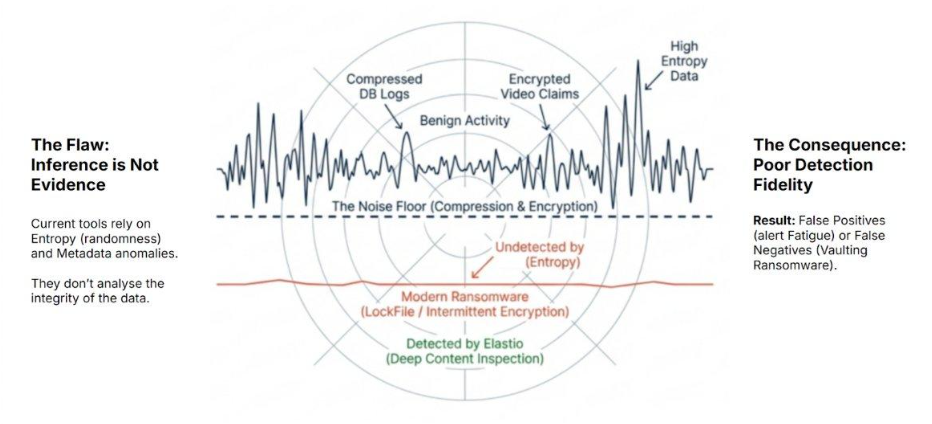
The False Security of Checked BoxesIn the high-stakes world of cyber-recovery, there is a dangerous assumption that "detection" is a binary state, either you have it or you don’t. Most backup vendors have checked the box by offering anomaly and entropy-based monitoring. But as a CISO who has spent over a decade in regulated industries, I’ve learned that a check-box control is often worse than no control at all. It creates a false sense of security while delivering a signal so noisy and inaccurate that it’s practically unusable. The Inaccuracy Problem: Inference Is Not Evidence The core issue with the ransomware detection provided by backup vendors isn’t just where it happens; it’s how it happens. These tools rely on statistical inference rather than data evidence: Anomaly Detection: Monitors for “unusual” behavior, like a sudden spike in changed blocks or a deviation in backup window duration.Entropy Detection: Measures data randomness to infer encryption. In a modern enterprise, data is naturally “noisy.” Compressed database logs, encrypted video files, and standard application updates all register as anomalies or high-entropy events. Because these tools cannot distinguish between a legitimate .zip file and a ransomware-encrypted .docx, they produce a constant stream of false positives. Figure 1: Modern ransomware (red) operates below the statistical noise floor while legitimate enterprise data generates constant false-positive noise. Elastio detects threats through structural content inspection, independent of entropy. For a SOC team, this noise is toxic. When a tool is consistently inaccurate, the human response is predictable: the alerts are muted, tuned down, or ignored. If your “last line of defense” relies on a signal that your team doesn’t trust, you don’t actually have a defense. Beyond the “Big Bang”: The Rise of Evasive Encryption Current anomaly and entropy tools were designed for the "Big Bang" encryption events of years past. As of 2026, threat actors have evolved well beyond this model, with variants including LockFile specifically engineered to stay below the statistical noise floor using intermittent encryption. Intermittent Encryption: Encrypting every other 4KB block so the overall entropy change remains negligible.Low-Entropy Encryption: Using specialized schemes that mimic the statistical signature of benign, compressed data.Selective Corruption: Attacking only file headers or metadata while leaving the bulk of the file statistically “normal.” Against these techniques, a statistical guess is useless. You need a Data Integrity Control that performs deep content inspection to validate the actual structure of the data, not just its randomness. Mapping Integrity to the Resilience Lifecycle A high-fidelity integrity engine, like Elastio, provides the same level of accuracy regardless of where it is deployed. However, for a CISO, the location of that check is a strategic decision based on the Resilience Lifecycle: The Backup Layer: Validating integrity here is non-negotiable. It ensures that when you hit “restore,” you aren’t re-injecting corrupted data into your environment and extending downtime.The Production Layer (VMs, Buckets, Filers): For mission-critical data, waiting for the backup cycle to run is a luxury we can’t afford. Detecting corruption at the source, in your production VMs, S3 buckets, or filers, is about minimizing the blast radius. Data integrity validation serves different purposes depending on where it is applied in the resilience lifecycle. Scanning production data across VMs, filers, and object stores is the most effective way to minimize blast radius and prevent spread, because it detects corruption before it propagates downstream. When production data cannot be scanned due to security boundaries, operational constraints, or tenancy limitations, snapshots and replicas become the practical control point for achieving the same outcome. In this model, snapshot integrity analysis is not additive to production scanning; it is a substitute. Both serve the same objective: early detection and containment before corruption reaches backups or immutable storage. The CISO’s Bottom Line: Proving vs. Guessing Resilience is measured by the speed and certainty of recovery. Anomaly and entropy-based detection fail on both counts: they are too inaccurate to provide certainty and too late to provide speed. True resilience requires moving from statistical inference to data integrity validation. Whether validating backups to prove recoverability or monitoring production data to prevent spread, the objective is the same: replace guessing with proof. In regulated environments, “recovery is safe” is the only defensible statement a CISO can make to the board. The ability to detect these advanced threats early is the difference between being able to ensure fast recovery versus a ransomware event that results in devastating downtime, data loss, and financial impact.

Elastio Software,  Ransomware
February 16, 2026

Cloud ransomware incidents rarely begin with visible disruption. More often, they unfold quietly, long before an alert is triggered or a system fails. By the time incident response teams are engaged, organizations have usually already taken decisive action. Workloads are isolated. Instances are terminated. Cloud dashboards show unusual activity. Executives, legal counsel, and communications teams are already involved. And very quickly, one question dominates every discussion. What can we restore that we actually trust? That question exposes a critical gap in many cloud-native resilience strategies. Most organizations have backups. Many have immutable storage, cross-region replication, and locked vaults. These controls are aligned with cloud provider best practices and availability frameworks. Yet during ransomware recovery, those same organizations often cannot confidently determine which recovery point is clean. Cloud doesn’t remove ransomware risk — it relocates it This is not a failure of effort. It is a consequence of how cloud architectures shift risk. Cloud-native environments have dramatically improved the security posture of compute. Infrastructure is ephemeral. Servers are no longer repaired; they are replaced. Containers and instances are designed to be disposable. From a defensive standpoint, this reduces persistence at the infrastructure layer and limits traditional malware dwell time. However, cloud migration does not remove ransomware risk. It relocates it. Persistent storage remains long-lived, highly automated, and deeply trusted. Object stores, block snapshots, backups, and replicas are designed to survive everything else. Modern ransomware campaigns increasingly target this persistence layer, not the compute that accesses it. Attackers don’t need malware — they need credentials Industry investigations consistently support this pattern. Mandiant, Verizon DBIR, and other threat intelligence sources report that credential compromise and identity abuse are now among the most common initial access vectors in cloud incidents. Once attackers obtain valid credentials, they can operate entirely through native cloud APIs, often without deploying custom malware or triggering endpoint-based detections. From an operational standpoint, these actions appear legitimate. Data is written, versions are created, snapshots are taken, and replication occurs as designed. The cloud platform faithfully records and preserves state, regardless of whether that state is healthy or compromised. This is where many organizations encounter an uncomfortable reality during incident response. Immutability is not integrity Immutability ensures that data cannot be deleted or altered after it is written. It does not validate whether the data was already encrypted, corrupted, or poisoned at the time it was captured. Cloud-native durability and availability controls were never designed to answer the question incident responders care about most: whether stored data can be trusted for recovery. In ransomware cases, incident response teams repeatedly observe the same failure mode. Attackers encrypt or corrupt production data, often gradually, using authorized access. Automated backup systems snapshot that corrupted state. Replication propagates it to secondary regions. Vault locks seal it permanently. The organization has not lost its backups. It has preserved the compromised data exactly as designed. Backup isolation alone is not enough This dynamic is particularly dangerous in cloud environments because it can occur without malware, without infrastructure compromise, and without violating immutability controls. CISA and NIST have both explicitly warned that backup isolation and retention alone are insufficient if integrity is not verified. Availability testing does not guarantee recoverability. Replication can accelerate the blast radius Replication further amplifies the impact. Cross-region architectures prioritize recovery point objectives and automation speed. When data changes in a primary region, those changes are immediately propagated to disaster recovery environments. If the change is ransomware-induced corruption, replication accelerates the blast radius rather than containing it. From the incident response perspective, this creates a critical bottleneck that is often misunderstood. The hardest part of recovery is deciding what to restore The hardest part of recovery is not rebuilding infrastructure. Cloud platforms make redeployment fast and repeatable. Entire environments can be recreated in hours. The hardest part is deciding what to restore. Without integrity validation, teams are forced into manual forensic processes under extreme pressure. Snapshots are mounted one by one. Logs are reviewed. Timelines are debated. Restore attempts become experiments. Every decision carries risk, and every delay compounds business impact. This is why ransomware recovery frequently takes days or weeks even when backups exist. Boards don’t ask “Do we have backups?” Boards do not ask whether backups are available. They ask which recovery point is the last known clean state. Without objective integrity assurance, that question cannot be answered deterministically. This uncertainty is not incidental. It is central to how modern ransomware creates leverage. Attackers understand that corrupting trust in recovery systems can be as effective as destroying systems outright. What incident response teams wish you had is certainty What incident response teams consistently wish organizations had before an incident is not more backups, but more certainty. The ability to prove, not assume, that recovery data is clean. Evidence that restoration decisions are based on validated integrity rather than best guesses made under pressure. Integrity assurance is the missing control This is where integrity assurance becomes the missing control in many cloud strategies. NIST CSF explicitly calls for verification of backup integrity as part of the Recover function. Yet most cloud-native architectures stop at durability and immutability. When integrity validation is in place, recovery changes fundamentally. Organizations can identify the last known clean recovery point ahead of time. Recovery decisions become faster, safer, and defensible. Executive and regulatory confidence improves because actions are supported by evidence. From an incident response standpoint, the difference is stark. One scenario is prolonged uncertainty and escalating risk. The other is controlled, confident recovery. Resilience is proving trust, not storing data Cloud-native architecture is powerful, but ransomware has adapted to it. In today’s threat landscape, resilience is no longer defined by whether data exists somewhere in the cloud. It is defined by whether an organization can prove that the data it restores is trustworthy. That is what incident response teams see after cloud ransomware. Not missing backups, but missing certainty. Certainty is the foundation of recovery And in modern cloud environments, certainty is the foundation of recovery.

Ransomware,  provable recovery
February 8, 2026

CMORG’s Data Vaulting Guidance: Integrity Validation Is Now a Core Requirement In January 2025, the Cross Market Operational Resilience Group (CMORG) published Cloud-Hosted Data Vaulting: Good Practice Guidance. It is a timely and important contribution to the operational resilience of the UK financial sector. CMORG deserves recognition for treating recovery architecture as a priority, not a future initiative. In financial services, the consequences of a cyber event extend well beyond a single institution. When critical systems are disrupted and recovery fails, the impact can cascade across customers, counterparties, and markets. The broader issue is confidence. A high-profile failure to recover can create damage that reaches far beyond the affected firm. This is why CMORG’s cross-industry collaboration matters. It reflects an understanding that resilience is a shared responsibility. Important Theme: Integrity Validation The guidance does a strong job outlining the principles of cloud-hosted vaulting, including isolation, immutability, access control, and key management. These are necessary design elements for protecting recovery data against compromise. But a highly significant element of the document is its emphasis on integrity validation as a core requirement. CMORG Foundation Principle #11 states: “The data vault solution must have the ability to run analytics against its objects to check integrity and for any anomalies without executing the object. Integrity checks must be done prior to securing the data, doing it post will not ensure recovery of the original data or the service that the data supported.” This is a critical point. Immutability can prevent changes after data is stored, but it cannot ensure that the data was clean and recoverable at the time it was vaulted. If compromised data is written into an immutable environment, it becomes a permanently protected failure point. Integrity validation must occur before data becomes the organization’s final recovery source of truth. CMORG Directly Addresses the Risk of Vaulting Corrupted Data CMORG reinforces this reality in Annex A, Use Case #2, which addresses data corruption events: “For this use case when data is ‘damaged’ or has been manipulated having the data vaulted would not help, since the vaulted data would have backed up the ‘damaged’ data. This is where one would need error detection and data integrity checks either via the application or via the backup product.” This is one of the most important observations in the document. Vaulting can provide secure retention and isolation, but it cannot determine whether the data entering the vault is trustworthy. Without integrity controls, vaulting can unintentionally preserve compromised recovery points. The Threat Model Has Changed The guidance aligns with what many organizations are experiencing in practice. Cyber-attacks are no longer limited to fast encryption events. Attackers increasingly focus on compromising recovery, degrading integrity over time, and targeting backups and recovery infrastructure. These attacks may involve selective encryption, gradual corruption, manipulation of critical datasets, or compromise of backup management systems prior to detonation. In many cases, the goal is to eliminate confidence in restoration and increase leverage during extortion. The longer these attacks go undetected, the more likely compromised data is replicated across snapshots, backups, vaults, and long-term retention copies. At that point, recovery becomes uncertain and time-consuming, even if recovery infrastructure remains available. Why Integrity Scanning Must Happen Before Data Is Secured CMORG’s point about validating integrity before data is secured is particularly important. Detection timing directly affects recovery outcomes. Early detection preserves clean recovery points and reduces the scope of failed recovery points. Late detection increases the likelihood that all available recovery copies contain the same corruption or compromise. This is why Elastio’s approach is focused on integrity validation of data before it becomes the foundation of recovery. Organizations need a way to identify ransomware encryption patterns and corruption within data early for recovery to be predictable and defensible. A Meaningful Step Forward for the Industry CMORG’s cloud-hosted data vaulting guidance represents an important milestone. It reflects a mature view of resilience that recognizes vaulting and immutability as foundational, but incomplete without integrity validation. The integrity of data must be treated as a primary control. CMORG is correct to call this out. It is one of the clearest statements published by an industry body on what effective cyber vaulting must include to support real recovery.

<img src="featured-image.jpg" alt="Cloud-native architecture ransomware risk and data integrity" />
Elastio Software,  Ransomware
February 8, 2026

Closing the Data Integrity Control Gap In 2025, the cybersecurity narrative shifted from protection to provable resilience. The reason? A staggering 333% surge in "Hunter-Killer" malware threats designed not just to evade your security stack, but to systematically dismantle it. For CISOs and CTOs in regulated industries, this isn't just a technical hurdle; it is a Material Risk that traditional recovery frameworks are failing to address. The Hunter-Killer Era: Blinding the Frontline The Picus Red Report 2024 identified that one out of every four malware samples now includes "Hunter-Killer" functionality. These tools, like EDRKillShifter, target the kernel-level "callbacks" that EDR and Antivirus rely on to monitor your environment. The Result: Your dashboard shows a "Green" status, while the adversary is silently corrupting your production data. This creates a Recovery Blind Spot that traditional, agent-based controls cannot see. The Material Impact: Unquantifiable Downtime When your primary defense is blinded, the "dwell time", the period an attacker sits in your network, balloons to a median of 11–26 days. In a regulated environment, this dwell time is a liability engine: The Poisoned Backup: Ransomware dwells long enough to be replicated into your "immutable" vaults.The Forensic Gridlock: Organizations spend an average of 24 days in downtime manually hunting for a "clean" recovery point.The Disclosure Clock: Under current SEC mandates, you have four days to determine the materiality of an incident. If you can’t prove your data integrity, you can’t accurately disclose your risk. Agentless Sovereignty: The Missing Control Elastio addresses the Data Integrity Gap by sitting outside the line of fire. By moving the validation layer from the compromised OS to the storage layer, we provide the only independent source of truth. The Control GapThe Elastio OutcomeAgent FragilityAgentless Sovereignty: Sitting out-of-band, Elastio is invisible to kernel-level "Hunter-Killer" malware.Trust BlindnessIndependent Truth: We validate data integrity directly from storage, ensuring recovery points are clean before you restore.Forensic LagMean Time to Clean Recovery (MTCR): Pinpoint the exact second of integrity loss to slash downtime from weeks to minutes. References & Sources GuidePoint Security GRIT 2026 Report: 58% year-over-year increase in ransomware victims.Picus Security Red Report 2024: 333% surge in Hunter-Killer malware targeting defensive systems.ESET Research - EDRKillShifter Analysis: Technical deep-dive into RansomHub’s custom EDR killer and BYOVD tactics.Mandiant M-Trends 2025: Median dwell time increases to 11 days; 57% of breaches notified by external sources.Pure Storage/Halcyon/RansomwareHelp: Average ransomware downtime recorded at 24 days across multiple industries in 2025.Cybereason True Cost to Business: 80% of organizations who pay a ransom are hit a second time.

<img src="featured-image.jpg" alt="Cloud-native architecture ransomware risk and data integrity" />
Elastio Software,  Ransomware
February 7, 2026

Cloud-Native Architectures Shift Ransomware Risk to Data Integrity While cloud platforms improve availability and durability through replication, immutability, and automated recovery, they do not ensure data integrity. In cloud-native environments, compute is ephemeral and identity-driven, but persistent storage is long-lived and highly automated. This shifts ransomware risk away from servers and toward data itself. Modern ransomware increasingly exploits compromised cloud credentials and native APIs to encrypt or corrupt data gradually, often without triggering traditional malware detection. As a result, immutable backups and replicas can faithfully preserve corrupted data, leaving organizations unable to confidently restore clean systems. Ransomware resilience in cloud-native architectures therefore requires data integrity validation: continuous verification that backups, snapshots, and storage objects are clean, recoverable, and provably safe to restore. Without integrity assurance, recovery decisions depend on manual forensics, increasing downtime, operational risk, and regulatory exposure. Executive Strategic Assessment We have successfully re-architected our enterprise for the cloud, adopting a model where compute is ephemeral and infrastructure is code. In this environment, we no longer repair compromised servers; we terminate them. This success has created a dangerous blind spot. By making compute disposable, we have migrated our risk entirely to the persistent storage layer (S3, EBS, FSx, RDS). Our current architectural controls—S3 Versioning, Cross-Region Replication, and Backup Vault Locks—are designed for Durability and Availability. They guarantee that data exists and cannot be deleted. They do not guarantee that the data is clean. In cloud-native security, data integrity means the ability to cryptographically and behaviorally verify that stored data has not been silently encrypted, corrupted, or altered before it is used for recovery. In a modern ransomware attack, the threat is rarely that you "lose" your backups; it is that your automated, immutable systems perfectly preserve the corrupted state. If we replicate an encrypted database to a compliance-mode vault, we have not preserved the business—we have simply "vaulted the virus."Under the shared responsibility model, cloud providers protect the availability of the platform, while customers retain responsibility for ensuring the correctness and integrity of the data they store and recover. This brief analyzes the Integrity Gap in cloud-native resilience. It details the architectural controls required to transition from assuming a clean recovery to algorithmically proving it, ensuring that when the Board asks, The New Risk Reality: Ephemeral Compute, Permanent Risk Our migration to cloud-native architectures on AWS has fundamentally shifted our risk profile. We have moved from "repairing servers" to "replacing them." Compute is now disposable (containers, serverless functions, auto-scaling groups) and identity is dynamic (short-lived IAM credentials). This is a security win for the compute layer because the "crime scene" effectively evaporates during an incident. Cloud changes where risk concentrates, not whether risk exists. Recent incident analysis shows stolen credentials as a leading initial access vector, with median attacker dwell time measured in days rather than months. This compression of time is what enables low-and-slow data corruption to outrun human-driven validation. Multiple industry investigations support this pattern, including Mandiant and Verizon DBIR reporting that credential abuse and identity compromise are now among the most common initial access vectors in cloud environments, with attackers often persisting long enough to corrupt data before detection. However, this architecture forces a massive migration of risk into the persistent storage layer. Modern ransomware attacks exploit this shift by targeting the integrity of the state itself. Attackers encrypt object stores, poison transaction logs, or utilize automation roles to mass-modify snapshots.Why aren’t cloud-native architectures inherently ransomware-safe? Because cloud controls prioritize availability and automation, not verification of data correctness at restore time. The Strategic Blind Spot: Immutability is Not Integrity Our current resilience strategy aligns with AWS Well-Architected frameworks. We rely heavily on Availability and Durability. We use S3 Versioning, AWS Backup Vault Locks, and Cross-Region Replication. These controls are excellent at ensuring data exists and cannot be deleted. However, they fail to ensure the data is clean. Integrity controls verify recoverability and correctness of restoration assets, not just retention. Operationally, this means validating data for encryption or corruption, proving restore usability, and recording a deterministic “last known clean” recovery point so restoration decisions do not depend on manual forensics. In a "Low and Slow" corruption attack, a threat actor uses valid, compromised credentials to overwrite data or generate new encrypted versions over weeks. In cloud environments, attackers increasingly encrypt or replace data using native storage APIs rather than custom malware. Once access is obtained, legitimate encryption and snapshot mechanisms can be abused to corrupt data while appearing operationally normal.This creates a failure mode unique to cloud-native architectures: attacks can succeed without malware, without infrastructure compromise, and without violating immutability controls. The "Immutable Poison" Problem: If an attacker encrypts a production database, Backups will dutifully snapshot that corruption. If Vault Lock is enabled, we effectively seal the corrupted state in a compliance-mode vault. We have preserved the attack rather than the business. Vault Locking prevents deletion and lifecycle modification of recovery points, including by privileged users. It does not validate the integrity or cleanliness of the data being ingested and retained.Replication Accelerates Blast Radius: Because replication is designed for speed (RPO), it immediately propagates the corrupted state to the DR region. The Missing Control: Recovery Assurance During a ransomware event, the most expensive resource is decision time. The Board will not ask "Do we have backups?" They will ask "Which recovery point is the last known good state?" Without a dedicated integrity control, answering this requires manual forensics. Teams must mount snapshots one by one, scan logs, and attempt trial-and-error restores. This process turns a 4-hour RTO into a multi-day forensic ordeal. Industry data shows that organizations take months to fully identify and contain breaches, and multi-environment incidents extend that timeline further. This gap is why recovery cannot depend on snapshot-by-snapshot investigation during an active crisis. Critically, integrity validation produces durable evidence, timestamps, scan results, and clean-point attestations that can be reviewed by executives, auditors, and regulators as part of post-incident assurance. Where Elastio Fits: The Integrity Assurance Layer Elastio fits into our architecture not as a backup tool, but as an Integrity Assurance Control (NIST CSF "Recover") that audits the quality of our persistence layer. Detection in Depth: Unlike EDR which monitors processes, Elastio watches the entropy and structure of the data itself. It scans S3 buckets and EBS snapshots for the mathematical signatures of encryption and corruption.Provable Recovery: Elastio indexes recovery points to algorithmically identify the "Last Known Clean" timestamp. This allows us to automate the selection of a clean restore point and decouple recovery time from forensic complexity. Platform Engineering Guide Architecture Context Elastio operates as an agentless sidecar. It utilizes scale-out worker fleets to mount and inspect storage via standard Cloud APIs (EBS Direct APIs, S3 GetObject, Azure APIs). It does not require modifying production workloads or installing agents on production nodes. Protection Capabilities by Asset Class 1. AWS S3 & Azure Blob Data Lakes Real-Time Inspection: The system scans objects in real-time as they are created. This ensures immediate detection of "infection by addition."Threat Hunting: If threats are found, automated threat hunts are performed on the existing objects/versions to identify the extent of the compromise.Recovery: The system identifies the last known clean version, allowing restores to be automated and precise. 2. Block Storage (EBS, EC2, Azure Disks, Azure VMs) Scale-Out Scanning: Automated scans of persistent storage are performed using ephemeral, scale-out clusters. This ensures that inspection does not impact the performance of the production workload.Policy Control: For long-lived workloads (e.g., self-hosted databases), policies control how frequently to scan (e.g., daily, hourly, or on snapshot creation) to balance assurance with cost. Integrity validation frequency must be faster than plausible time-to-impact. With ransomware dwell time measured in days, weekly validation leaves material integrity gaps. For critical, high-risk workloads, production data validation can be configured to run as frequently as hourly, based on policy and business criticality, while lower-risk assets can operate at longer intervals to balance assurance, cost, and operational impact. 3. AWS Backup Scan-on-Create: Automated scanning of backups occurs immediately as they are created.Asset Support: Supports EC2, EBS, AMI, EFS, FSx, and S3 backup types.Vault Integration: Fully integrated with AWS Backup Restore Testing and Logically Air-Gapped (LAG) Vaults, ensuring that data moving into high-security vaults is verified clean before locking. 4. Azure Backup Scan-on-Create: Automated scanning of backups occurs immediately as they are created.Asset Support: Supports Azure VM, Azure Managed Disks, and Azure Blobs. 5. Managed Databases (RDS / Azure Managed SQL) Status: Not Supported.Note: Direct integrity scanning inside managed database PaaS services is not currently supported. Table 1: Threat Manifestation & Control Fit Architecture ComponentThe "Native" Failure ModeProtection Available (Elastio)AWS S3 / Azure Blob"Infection by Addition"Ransomware writes new encrypted versions of objects. The bucket grows, and "current" versions are unusable.Real-Time Detection & HuntingScans real-time as objects are created. Automates threat hunts for last known clean versions. Automates restores.EC2 / Azure VMs(Self-Hosted DBs)The "Live Database" AttackAttackers encrypt database files (.mdf, .dbf) while the OS remains up. Standard snapshots capture the encrypted state.Automated Integrity ScansAutomated scans of persistent storage in scale-out clusters. Policies control scan frequency for long-lived workloads.AWS BackupVault PoisoningWe lock a backup that was already compromised (Time-to-detect > Backup Frequency).Scan-on-Create (Vault Gate)Automated scanning of backups (EC2, EBS, AMI, EFS, FSx, S3) as they are created. Integrated with AWS Restore Test and LAG Vaults.Azure BackupReplica CorruptionBackup vaults replicate corrupted recovery points to paired regions.Scan-on-CreateAutomated scanning of Azure VM, Managed Disk, and Blob backups as they are created.Managed DBs(RDS / Azure Managed SQL)Logical CorruptionValid SQL commands drop tables or scramble columns.Not SupportedIn these environments, integrity assurance must be addressed through complementary controls such as transaction log analysis, application-layer validation, and point-in-time recovery testing. Conclusion Adopting this control moves us from a posture of "We assume our immutable backups are valid" to "We have algorithmic proof of which recovery points are clean." In an era of compromised identities, this verification is the requisite check-and-balance for cloud storage. This control removes uncertainty from recovery decisions when time, trust, and data integrity matter most.In cloud-native environments, ransomware resilience is no longer defined by whether data exists, but by whether its integrity can be continuously proven before recovery.In practical terms, any cloud-native ransomware recovery strategy that cannot deterministically identify a last known clean recovery point before restoration should be considered operationally incomplete. This perspective reflects patterns we consistently see in enterprise incident response, including insights shared by Elastio advisors with deep experience leading ransomware investigations and cloud recovery efforts.

Elastio Software,  Ransomware
February 1, 2026

Elastio and AWS recently hosted a joint webinar, “Modern Ransomware Targets Recovery: Here’s What You Can Do to Stay Safe.” The session brought together experts to unpack how ransomware tactics are evolving and what organizations need to do differently to stay resilient. A clear theme emerged. Attackers are no longer focused on disruption alone. They are deliberately sabotaging recovery. Ransomware Has Shifted From Disruption to Recovery Sabotage Modern ransomware no longer relies on fast, obvious encryption of production systems. Instead, attackers often gain access months in advance. They quietly study the environment, including backup architectures, replication paths, and retention windows. Encryption happens slowly and deliberately, staying below detection thresholds while corrupted data propagates into snapshots, replicas, and backups. By the time the attack is triggered and ransom is demanded, recovery options are already compromised. This represents a fundamental shift in risk. Backups are no longer just a safety net. They are a primary target. Ransomware Risk Is Unquantifiable Without Proven Clean Recovery Points Ransomware risk becomes impossible to quantify when organizations cannot prove their recovery data is clean. Boards, regulators, and insurers are no longer reassured by the mere existence of backups. They want to know how quickly recovery can happen, which recovery point will be used, and how its integrity is verified. Most organizations cannot answer these questions with confidence because backup validation is not continuous. The consequences are real. Extended downtime, board-level exposure, insurance gaps, and growing regulatory pressure under frameworks such as DORA, NYDFS, and PRA. Without proven clean recovery points, ransomware becomes an unbounded business risk rather than a technical one. The Three Pillars of Ransomware Recovery Assurance The webinar emphasized that real ransomware resilience depends on three pillars working together. Immutability and isolation ensure backups are tamper-proof and stored separately, protected by independent encryption keys. AWS capabilities such as logically air-gapped vaults support this foundation.Availability focuses on whether recovery can happen fast enough to meet business expectations, particularly when identity systems are compromised. Clean-account restores and multi-party approval become critical.Integrity, the most overlooked pillar, ensures backups are continuously validated to detect encryption, corruption, malware, and fileless attacks, and to clearly identify the last known clean recovery point. If any pillar fails, recovery fails. For more information: Resilience by design: Building an effective ransomware recovery strategy | AWS Storage Blog Malware Scanning Is Not Ransomware Detection The speakers drew a clear distinction between traditional malware scanning and what is required to defend against modern ransomware. Signature-based tools look for known binaries, but today’s attacks often run in memory, use polymorphic techniques, and encrypt data without leaving a detectable payload. In these cases, the absence of malware does not mean the absence of damage. Effective ransomware defense requires detecting the impact on data itself, including encryption, corruption, and abnormal change patterns, not just the presence of malicious code. Validation Enables Faster, Safer Recovery Without Paying Ransom A real-world case study illustrated the value of recovery validation. Attackers encrypted data gradually over several days, allowing compromised data to flow into backups that appeared intact but were unsafe to restore. Through targeted threat hunting, Elastio identified a clean recovery point from roughly six days earlier, enabling the company to restore operations without paying the ransom. With downtime costs often reaching millions per day, even small reductions in recovery time have outsized financial impact. The takeaway was simple. Knowing where to recover from matters more than recovering quickly from the wrong place. Key Takeaways Ransomware now targets recovery, not just production.Attackers gain access early, encrypt data slowly, and ensure corruption spreads into replicas and backups before triggering an attack. By the time ransom is demanded, recovery paths are often already compromised.Backups alone are not proof of recoverability.Without continuous validation, organizations cannot confidently identify a clean recovery point, making ransomware risk impossible to quantify.True ransomware resilience depends on three pillars.Immutability and isolation protect backups from tampering, availability ensures recovery meets business expectations, and integrity validation confirms recovery data is usable. If integrity fails, recovery fails.Malware detection is not ransomware detection.Fileless and polymorphic attacks often evade signature-based tools. Detecting the impact on data, such as encryption and corruption, is critical.Provable recovery changes the economics of ransomware.Validated recovery points reduce downtime, avoid reinfection, and can eliminate the need to pay ransom, delivering measurable operational and financial impact. Additional Resources AWS ReInvent: How Motability Operations built a ransomware-ready backup strategy with AWS Backup & Elastio AWS re:Invent 2025 - Motability Operations' unified backup strategy: From fragmented to fortified

Elastio Software
January 22, 2026

In early 2026, U.S. authorities issued a cyber threat alert warning organizations about evolving tactics used by North Korean state-sponsored cyber actors. The advisory highlights how the Democratic People’s Republic of Korea (DPRK) continues to refine its cyber operations to conduct espionage, gain persistent access to networks, and generate revenue to support state objectives. This activity underscores a broader reality: DPRK cyber operations are no longer niche or experimental. They are mature, adaptive, and increasingly effective against both public- and private-sector targets. Evolving Tradecraft: From Phishing to QR Code Attacks A key focus of the alert is the growing use of malicious QR codes embedded in phishing emails, a technique often referred to as “quishing.” Instead of directing victims to malicious links, attackers embed QR codes that prompt users to scan them with mobile devices. This approach allows attackers to bypass traditional email security controls and exploit weaker defenses on mobile platforms. Once scanned, these QR codes redirect victims to attacker-controlled pages that closely mimic legitimate login portals, such as enterprise email or remote access services. Victims who enter their credentials unknowingly hand over access to their accounts, enabling attackers to move laterally, conduct follow-on phishing campaigns, or establish long-term persistence. Kimsuky and Targeted Espionage The activity described in the alert is attributed to a DPRK-linked cyber group commonly referred to as Kimsuky. This group has a long history of targeting policy experts, think tanks, academic institutions, and government entities, particularly those involved in foreign policy and national security issues related to the Korean Peninsula. What distinguishes recent campaigns is the subtlety of the lures and the deliberate exploitation of user trust. Emails are crafted to appear routine or administrative, and QR codes are presented as harmless conveniences. This increases the likelihood of successful compromise, even in security-aware environments. Cybercrime as Statecraft DPRK cyber operations should not be viewed solely through the lens of traditional espionage. North Korea has repeatedly demonstrated its willingness to use cybercrime as a strategic tool. In parallel with intelligence collection, DPRK-linked actors have conducted financially motivated attacks, including cryptocurrency theft, financial fraud, and illicit remote employment schemes. These activities serve a dual purpose: generating revenue to circumvent international sanctions and providing operational cover for broader intelligence objectives. In many cases, what appears to be simple fraud is ultimately tied to state-directed priorities. Why This Matters Now The techniques outlined in the 2026 alert highlight how DPRK cyber actors are adapting faster than many defensive programs. By shifting attacks to mobile devices, exploiting human behavior, and blending espionage with financial crime, they reduce the effectiveness of traditional security controls. For organizations, this means that technical defenses alone are no longer sufficient. User awareness, mobile security posture, identity protection, and anomaly detection all play a critical role in mitigating risk. Key Takeaways for Organizations Organizations should assume that DPRK cyber activity will continue to evolve and expand in scope. Practical steps include updating security awareness training to address QR code–based attacks, monitoring for anomalous authentication behavior, limiting credential reuse, and treating identity compromise as a high-impact security incident. Most importantly, leaders should recognize that DPRK cyber operations are persistent, well-resourced, and strategically motivated. Understanding this threat is essential not only for government and policy organizations, but for any enterprise operating in an increasingly interconnected and geopolitically influenced digital environment.

Elastio Software
December 24, 2025

Detonation Point is where cyber risk stops being an abstract headline and becomes an operational reality. In a recent episode presented by Elastio, host Matt O’Neill sat down with cloud security expert Costas Kourmpoglou at Spike Reply UK to unpack a hard truth many organizations only learn after an incident: Ransomware doesn’t succeed because attackers are smarter; it succeeds because recovery fails. Ransomware Is an Industry Early ransomware operations were vertically integrated. The same group wrote the malware, gained access, deployed it, negotiated payment, and laundered funds. That model is gone. Today’s ransomware ecosystem resembles a supply chain: Developers build ransomware toolingInitial access brokers sell credentialsAffiliates deploy attacksNegotiators manage extortionSeparate actors handle payments and laundering This “Ransomware-as-a-Service” model lowers the barrier to entry and scales attacks globally. No one really needs expert technical skills. They just need access and opportunity. How Daily Mistakes Set Ransomware in Motion Ransomware became dominant for a straightforward reason: it pays. Despite headlines about zero-day exploits, most ransomware campaigns still begin with mundane failures: Reused credentialsPhishing emailsThird-party access The uncomfortable reality is that most organizations already assume breaches, yet design security as if prevention is enough. In this Detonation Point podcast, Costas noted, “Many teams over-invest in stopping the first mistake and under-invest in what happens after that mistake inevitably occurs.” Attackers don’t rush. Once inside, they: Observe quietly and use native tools to blend in (“living off the land”)Map systems and privilegesIdentify backups and recovery paths Ransomware often detonates months after initial access and long after backups have quietly captured infected data. But Why Paying the Ransom Rarely Works Ransomware payments are often justified as the “cheapest option.” But data tells a different story: Recovery success after payment is worse than a coin flipPayments may violate sanctions lawsData is often not fully restored or released anyway As Costas put it, “If you’re willing to gamble on paying the ransom, you might as well invest that money in resilience, where the odds are actually in your favor.” One of the most critical insights from the conversation was this: If your business cannot operate, that is not just a cybersecurity failure, it’s a business failure. If your plan assumes everything else still works, it’s not a plan. And, if ransomware detonated tonight, do you know which recovery path would save you, and which ones would make things worse? Because when ransomware stops being theoretical, only validated recovery determines the outcome. This blog is adapted from the Detonation Point podcast presented by Elastio.

Elastio × AWS GuardDuty — Automated Scans for Malware
Elastio Software,  Ransomware
December 22, 2025

GuardDuty’s release of malware scanning on AWS Backup is an important enhancement to the AWS ecosystem, reflecting growing industry recognition that inspecting backup data has become a core pillar of cyber resilience. But real-world incidents show that ransomware often leaves no malware behind, making broader detection capabilities for encryption and zero-day attacks increasingly essential. Across industries, there are countless examples of enterprises with premium security stacks in place - EDR/XDR, antivirus scanners, IAM controls - still suffering extended downtime after an attack because teams couldn’t reliably identify an uncompromised recovery point when it mattered most. That’s because ransomware increasingly employs fileless techniques, polymorphic behavior, living-off-the-land tactics, and slow, stealthy encryption. These campaigns often reach backup andreplicated copies unnoticed, putting recovery at risk at the very moment organizations dependon it. As Gartner puts it: Modern ransomware tactics bypass traditional malware scanners, meaning backups may appear ‘clean’ during scans but prove unusable when restored. Equip your recovery environment with advanced capabilities that analyze backup data using content-level analytics and data integrity validation.”— Gartner, Enhance Ransomware Cyber Resilience With A Secure Recovery Environment, 2025 This is the visibility gap Elastio was designed to close. In this post, we walk through how Elastio’s data integrity validation works alongside AWS GuardDuty to support security and infrastructure teams through threat detection all the way to recovery confidence and why integrity validation has become essential in the age of identity-based and fileless attacks. What is AWS GuardDuty? AWS GuardDuty is a managed threat detection service that continuously monitors AWS environments for malicious or suspicious activity. It analyzes signals across AWS services, including CloudTrail, VPC Flow Logs, DNS logs, and malware protection scans, and produces structured security findings. GuardDuty integrates natively with Amazon EventBridge, which means every finding can be consumed programmatically and routed to downstream systems for automated response. For this integration, we focus on GuardDuty malware findings, including: Malicious file findings in S3Malware detections in EC2 environments These findings are high-confidence triggers that indicate potential compromise and warrant immediate validation of recovery data. Learn more about GuardDuty. Why a GuardDuty Finding Should Trigger Recovery Validation Malware detection is important, but it is no longer sufficient to validate data recoverability. Identity-based attacks dominate cloud breaches Today’s attackers increasingly rely on stolen credentials rather than exploits. With valid identities, they can: Use legitimate AWS APIsAccess data without dropping malwareBlend into normal operational behavior In these scenarios, there may be nothing malicious to scan, yet encryption or tampering can still occur. Fileless and polymorphic ransomware evade signatures Many ransomware families: Run entirely in memoryContinuously mutate their payloadsAvoid writing recognizable artifacts to disk Signature-based scanners may report “clean,” even as encryption spreads. Zero-day ransomware has no signatures By definition, zero-day ransomware cannot be detected by known signatures until after it has already caused damage - often widespread damage. The result is a dangerous failure mode: backups that scan clean but restore encrypted or corrupted data. Why Integrity Validation Changes the Outcome Elastio approaches ransomware from the impact side. Instead of asking only “is malware present?”, Elastio validates: Whether encryption has occurredWhat data was impactedWhen encryption startedWhich recovery points are still safe to restore The timeline above reflects a common real-world pattern: Initial access occurs quietlyEncryption begins days or weeks laterBackups continue, unknowingly capturing encrypted dataThe attack is only discovered at ransom time Without integrity validation, teams cannot know with confidence that their backups will work when they need them. This intelligence transforms a GuardDuty finding from an alert into an actionable recovery decision. Using GuardDuty as the Trigger for Recovery Validation Elastio’s new GuardDuty integration automatically initiates data integrity scans when GuardDuty detects suspicious or malicious activity. Instead of stopping at alerts, the integration immediately answers the implied next question: Did this incident affect our data, and can we recover safely? By validating backups and recovery assets in response to GuardDuty findings, Elastio reduces response time, limits attacker leverage, and enables faster, more confident recovery decisions. Architecture Overview At a high level: GuardDuty generates a malware findingThe finding is delivered to EventBridgeEventBridge routes the event into a trusted sender EventBusElastio’s receiver EventBus accepts events only from that senderElastio processes the finding and starts a targeted scanTeams receive recovery-grade intelligenceIncluding:Ransomware detection resultsFile- and asset-level impactLast known clean recovery pointOptional forwarding to SIEM or Security Hub The critical design constraint: trusted senders Each Elastio customer has a dedicated Receiver EventBus. For security reasons, that receiver only accepts events from a single allowlisted Sender EventBus ARN. This design ensures: Strong tenant isolationNo event spoofingClear security boundaries To support scale, customers can route many GuardDuty sources (multiple accounts, regions, or security setups) into that single sender bus. Elastio enforces trust at the receiver boundary. End-to-End Flow Step 1: GuardDuty detects malware GuardDuty identifies a malicious file or suspicious activity in S3 or EC2 and emits a finding. Step 2: EventBridge routes the finding Native EventBridge integration allows customers to filter and forward only relevant findings. Step 3: Sender EventBus enforces trust All GuardDuty findings flow through the designated sender EventBus, which represents the customer’s trusted identity. Step 4: Elastio receives and buffers events The Elastio Receiver EventBus routes events into an internal queue for resilience and burst handling. Step 5: Elastio validates recovery data Elastio maps the finding to impacted assets and initiates scans that analyze both malware indicators and ransomware encryption signals. Step 6: Recovery-grade results Teams receive actionable results: Ransomware detectionFile-level impactLast known clean recovery pointOptional forwarding to SIEM or Security Hub What This Enables for Security and Recovery Teams By combining GuardDuty and Elastio, organizations gain: Faster response triggered by high-signal findingsEarly detection of ransomware encryption inside backupsReduced downtime and data lossConfidence that restores will actually workAudit-ready evidence for regulators, insurers, and leadership Supported Today S3 malware findingsEC2 malware findings EBS-specific handling is in progress and will be added as it becomes available. Why This Matters in Practice In most ransomware incidents, the challenge isn’t identifying a security signal - it’s understanding whether that signal corresponds to meaningful data impact, and what it implies for recovery. Security and infrastructure teams often find themselves piecing together information across multiple tools to assess whether encryption or corruption has reached backups or replicated data. That assessment takes time, and during that window, recovery decisions are delayed or made conservatively. By using GuardDuty findings as a trigger for integrity validation, customers introduce earlier visibility into potential data impact. When suspicious activity is detected, Elastio provides additional context around whether recovery assets show signs of encryption or corruption, and which recovery points appear viable. This doesn’t replace incident response processes or recovery testing, but it helps teams make better-informed decisions sooner, particularly in environments where fileless techniques and identity-based attacks limit the effectiveness of traditional malware scanning. Extending GuardDuty From Detection Toward Recovery Readiness GuardDuty plays a critical role in surfacing high-confidence security findings. Elastio extends that signal into the recovery domain by validating the integrity of data organizations may ultimately depend on to restore operations. Together, they help teams bridge the gap between knowing an incident may have occurred and assessing recovery readiness, with supporting evidence that can be shared across security, infrastructure, and leadership teams. For organizations already using GuardDuty, this integration provides a practical way to connect detection workflows with recovery validation without changing existing security controls or response ownership. Watch our discussion: Understanding Elastio & AWS GuardDuty Malware Scanning for AWS Backup An open conversation designed to answer customer questions directly and help teams understand how these technologies work together to strengthen recovery posture. How signature-based malware detection compares to data integrity validationReal-world scenarios where behavioral and encryption-based detection mattersHow Elastio extends visibility, detection, and recovery assurance across AWS, Azure, and on-prem environmentsAn early look at Elastio’s new integration launching at AWS re:Invent

Unmasking
Elastio Software,  Ransomware
December 5, 2025

Hunting and Defeating EDR-Evading Threats and Machine-Identity Attacks As enterprises accelerate cloud transformation, containerization, AI adoption, microservices, and automation, a subtle yet profound shift is reshaping the cyber threat landscape. Traditional endpoint-based detection approaches are no longer sufficient. Attackers are increasingly evading EDR, while simultaneously exploiting a rapidly expanding universe of machine identities such as service accounts, certificates, API keys, and ephemeral workload tokens. This creates a new, invisible attack surface that is often unmonitored, ungoverned, and misunderstood. To defend effectively, organizations must evolve. The new model brings together endpoint awareness, identity intelligence, and data-layer resilience to expose threats that would otherwise remain invisible. The EDR Blind Spot Is Widening Endpoint Detection and Response has been the backbone of enterprise defense. But adversaries have learned to systematically bypass it through techniques that interfere with telemetry, suppress alerts, operate from memory, or shift their activity into systems or layers where EDR agents cannot run. Some threat groups have deployed tooling that disables endpoint monitoring components entirely, allowing operations to continue with little or no visibility for defenders. At the same time, many critical infrastructure components do not support EDR at all. Hypervisors, storage appliances, virtual machine management systems, and specialized cloud services often sit outside traditional endpoint protections. Attackers increasingly target these layers because activity there blends in with normal operations and rarely triggers alarms. As a result, relying solely on endpoint-centric detection creates blind spots that grow wider as modern infrastructure becomes more distributed. The Explosion of Machine Identities and the Risks They Introduce While EDR evasion grows more sophisticated, another trend has emerged in parallel: the exponential rise of machine identities. These are non-human actors created by automation pipelines, containers, microservices, serverless functions, AI agents, DevOps tooling, and cloud services. Machine identities now outnumber human identities in most cloud-forward enterprises by enormous margins. They often carry privileged permissions, access sensitive data paths, or control critical infrastructure functions. Unlike human accounts, these identities rarely follow standardized onboarding, governance, audit, or lifecycle processes. Many are short-lived, created and destroyed automatically, leaving gaps in visibility. Others live far longer than intended because no one realizes they still exist. Attackers increasingly target these identities because compromising one can grant immediate and legitimate access to high-value systems or data. The activity of a hijacked machine identity blends in naturally with expected automation patterns, making detection difficult. In many cases, the identity itself becomes the persistence mechanism. Identity Becomes the New Perimeter These dynamics undermine a core assumption behind many security architectures: that identity governance is equivalent to human access control. In cloud-native enterprises, identity is now as much about workloads as it is about people. When machine identities are not continuously monitored, governed, and validated, they become powerful tools for stealthy lateral movement or data manipulation. This means identity has truly become the perimeter. But it is a perimeter that cannot be secured solely with human-centric tools. The Data Layer Is Where Invisible Threats Finally Become Visible Machine identities interact with data continuously. They create snapshots, move objects across storage tiers, generate logs, trigger analytics pipelines, replicate datasets, and run unattended processes. If one of these identities is compromised, the first signs of malicious activity often appear in the data layer itself. Unauthorized reads, unexpected modifications, corruption of snapshots, tampered metadata, irregular replication events, or the introduction of malicious content are often the earliest and most reliable indicators of attack. By the time endpoint or identity systems raise alerts, the attacker may have already altered data across multiple systems. This is why modern cyber resilience depends on the ability to continuously verify the integrity, security, and recoverability of data itself. A Modern Defense Model Addressing these emerging threats requires a multi-layered approach that blends identity, workload, and data-centric controls. First, all machine identities must be governed with the same rigor as human identities. This means complete inventory, lifecycle management, least-privilege enforcement, short-lived credential use, and continuous monitoring of identity behavior.Second, detection must expand beyond endpoints. Organizations need visibility into identity issuance, API usage, workload behavior, cloud control-plane activity, and infrastructure components that do not support traditional EDR.Third, data integrity must be continuously validated. Snapshots, backups, object data, and replicated datasets must be automatically and regularly inspected. Any unauthorized change or anomaly should be treated as a leading indicator of potential compromise.Fourth, Zero Trust principles must be deeply embedded in the machine and data layers. Verification is no longer only about authenticating a user. It is about verifying the legitimacy of every process, every identity, and every piece of data flowing through the enterprise. Why This Approach Is Strategic Adversaries are adapting quickly. They no longer need to compromise a human identity or bypass every endpoint. They can operate quietly within automation systems, exploit permissions given to machine identities, or target data itself as the first point of manipulation. By addressing machine identity governance and data integrity together, organizations reduce the inherent weaknesses of endpoint-only detection. They gain a defensive architecture that detects threats earlier, responds more effectively, and ensures business continuity even under active attack. The combination of EDR evasion and machine-identity exploitation represents one of the most significant emerging risks to modern enterprises. Attackers are learning to operate invisibly, bypassing traditional controls and embedding themselves in the automation and data layers where detection is weakest. To win in this environment, security teams must shift their mindset. They must unmask the invisible by looking where attackers now hide: in identities, in the control plane, and in the data itself. They must verify continuously, trust nothing implicitly, and safeguard the integrity of the information the business depends on. This is how modern organizations stay resilient. It is how they transform uncertainty into strength. And it is how they defeat adversaries who no longer need to be seen to be dangerous. This is the gap Elastio is built to close. Schedule a review. 3 Key Takeaways EDR alone leaves growing visibility gapsMachine identities are the new attack surfaceData integrity becomes the ultimate detection layer

An open bank vault door
Elastio Software,  Ransomware,  Cyber Recovery
December 5, 2025

AI-Ready & Ransomware-Proof FSx for NetApp ONTAP Amazon FSx for NetApp ONTAP (FSxN) has become the gold standard for high-performance cloud storage, combining the agility of AWS with the data management power of NetApp. Today, this infrastructure is more critical than ever. As unstructured data volumes explode and enterprises race to feed Generative AI models, FSxN has evolved into the engine room for innovation. It holds the massive datasets that fuel your AI insights and drive business logic. You cannot build trusted AI on unverified data FSxN delivers the trusted, high-performance platform your enterprise relies on. But true trust requires more than uptime—it requires integrity. As enterprise architectures evolve, so do the threats targeting them. The sheer scale of unstructured data creates a massive blind spot where ransomware can hide, silently corrupting data over weeks. If the data residing on your trusted storage is compromised, your AI models are being trained on poisoned assets. The Imperative: Verified Data for Trusted AI Today, Elastio is introducing comprehensive Ransomware Recovery Assurance for Amazon FSx for NetApp ONTAP. We now provide a layered defense that validates the integrity of the data within your primary volumes, SnapMirror replicas, and AWS Backups, ensuring that your storage is not just available, but provably clean. The Three-Tier Defense for FSxN To understand where Elastio fits, we must look at the modern FSxN protection architecture. A resilient implementation typically relies on three layers : Primary Filer: Your active, high-performance workload.SnapMirror Replica: A near-real-time, read-only copy used for disaster recovery with low RPOs (e.g., 5 minutes).AWS Backup: A daily recovery point for long-term retention and compliance. Until now, verified recoverability across these layers was a blind spot. Elastio eliminates that uncertainty by integrating with the entire chain to validate data integrity before a crisis occurs. The Risk of Silent Corruption Ransomware attacks frequently begin subtly, bypassing perimeter defenses and modifying data blocks without triggering immediate alerts. If these corrupted blocks are replicated to your SnapMirror destination or archived into your AWS Backup vault, you aren't preserving your business—you are preserving the attack. Just having backups is not enough. To ensure resilience, you must answer three questions about your recovery points : Are they safe?Are they intact?Are they recoverable? Introducing Elastio Recovery Assurance for FSxN Elastio delivers agentless, automated verification for FSxN environments. Our platform connects to your infrastructure to perform deep-file inspection, providing : Behavioral Ransomware Detection: We identify encryption patterns that signature-based tools miss, including slow-rolling and obfuscated encryption.Insider Threat Detection: We detect malicious tampering or unauthorized encryption driven by compromised credentials.Corruption Validation: We identify unexpected data corruption that could render a backup unusable during a restore. This coverage spans the entire lifecycle. Elastio scans your SnapMirror replicas for immediate RPO validation and utilizes AWS Restore Testing to validate your AWS Backups without rehydrating production data. Complementing NetApp’s Native Defenses Elastio is designed to work with your existing security stack, not replace it. NetApp’s native Autonomous Ransomware Protection (ARP) is an excellent first line of defense, monitoring your production environment for suspicious activity in real-time. Elastio complements ARP by operating beyond the production path. We focus on the recovery chain, performing deep-dive analysis on your backups and replicas. If ARP flags a potential threat in production, Elastio allows you to instantly identify which historical recovery point is clean, verifiable, and safe to restore . Compliance: From "Prevention" to "Proof" Regulatory pressure is shifting. Frameworks like DORA, NYDFS, HIPAA, and PCI-DSS are moving away from simple backup retention mandates toward requirements for demonstrable recovery integrity. Auditors and cyber insurers no longer accept "we have backups" as an answer. They require proof that those backups can be restored. Elastio automates this reporting, providing a validated inventory of clean snapshots that satisfies the most stringent compliance and risk requirements. Recommended Architecture for Provable Recovery To achieve maximum resilience with FSxN, we recommend the following layered approach : Replicate: Use SnapMirror to maintain a secondary copy with a 5-minute RPO.Retain: Use AWS Backup to enforce retention policies.Validate:Run Elastio Hourly Scans on SnapMirror replicas to catch infection early.Run Elastio Restore Tests monthly on AWS Backups to verify your vault. Conclusion In the current threat landscape, ransomware is not a matter of if, but when. Your data is only protected if it can be recovered. With Elastio’s new support for Amazon FSx for NetApp ONTAP, you can move beyond checking a backup box and gain true recovery assurance. In just minutes per TB, you will know if your data is clean or compromised, and be ready to recover with confidence. 3 Key Takeaways AI Integrity Requires Clean Data As FSxN drives generative AI and unstructured data growth, silent corruption becomes a critical risk. Elastio prevents "poisoned" datasets by detecting corruption inside the storage layer.End-to-End Validation Elastio secures the entire FSxN lifecycle, providing deep inspection and clean recovery verification for primary volumes, SnapMirror replicas, and AWS Backups.The "Production and Recovery" Defense Elastio operates outside the production path to complement NetApp’s Autonomous Ransomware Protection (ARP), validating snapshots to ensure you always have a safe place to restore from.

Elastio Software,  Ransomware,  Cyber Recovery
December 5, 2025

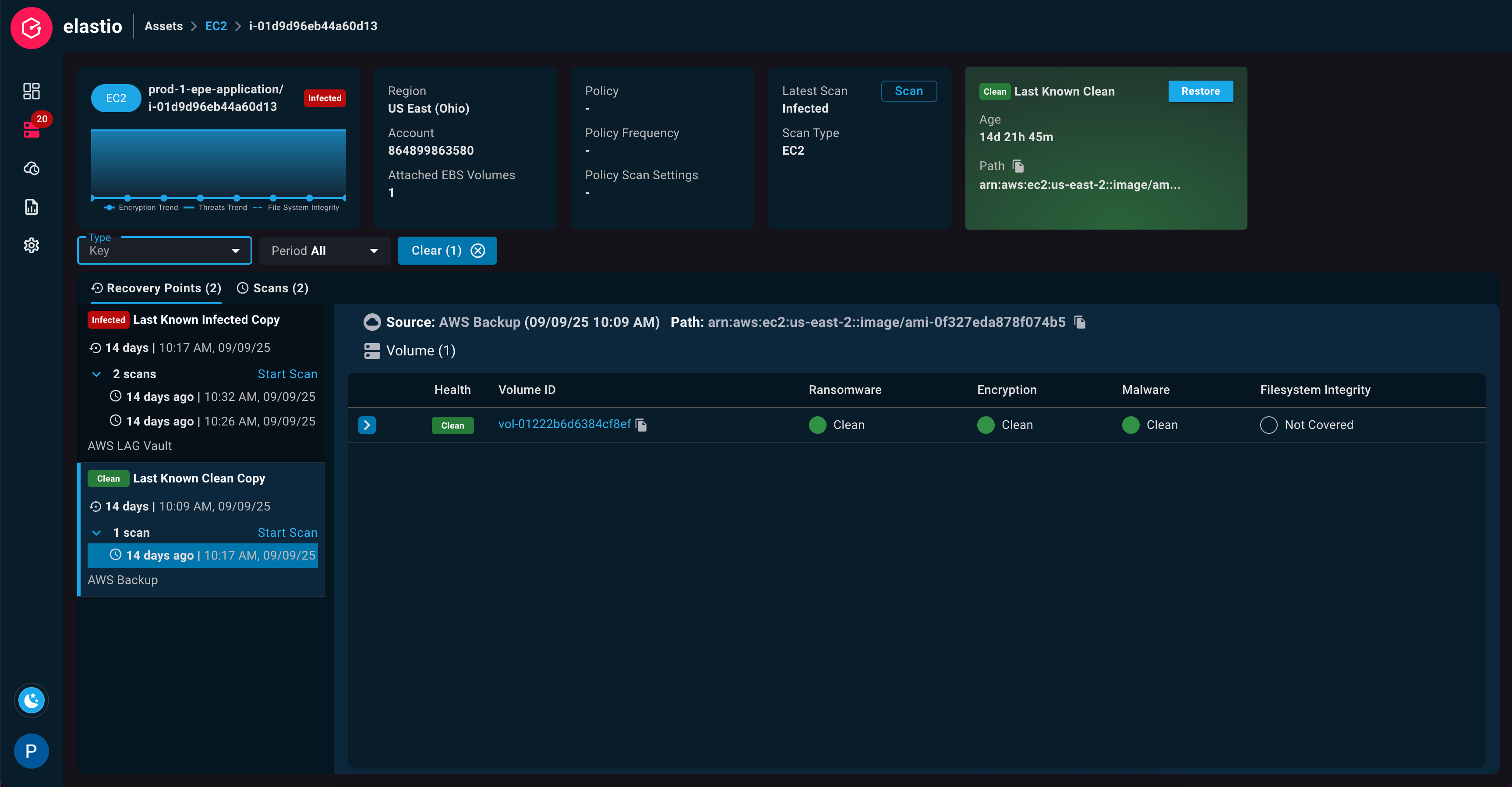
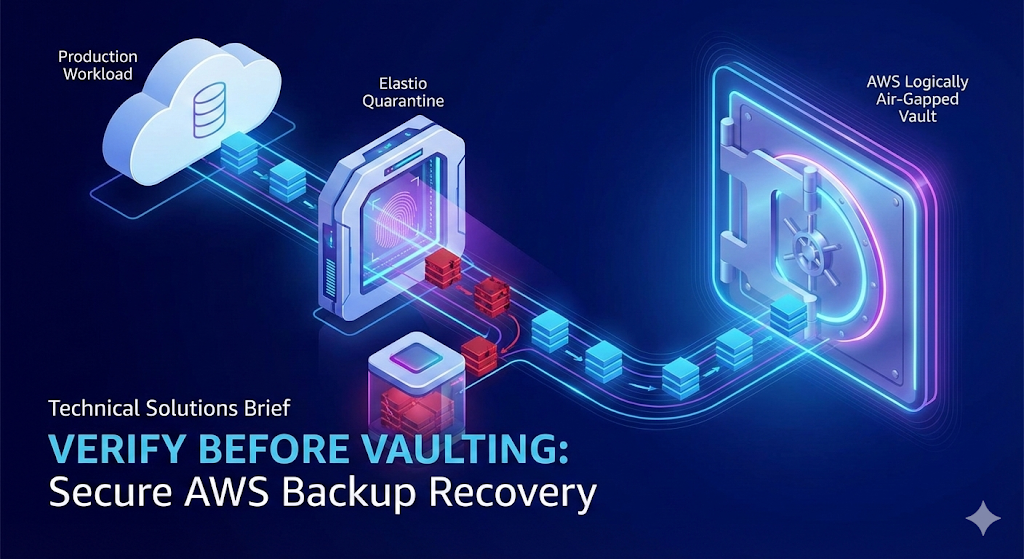
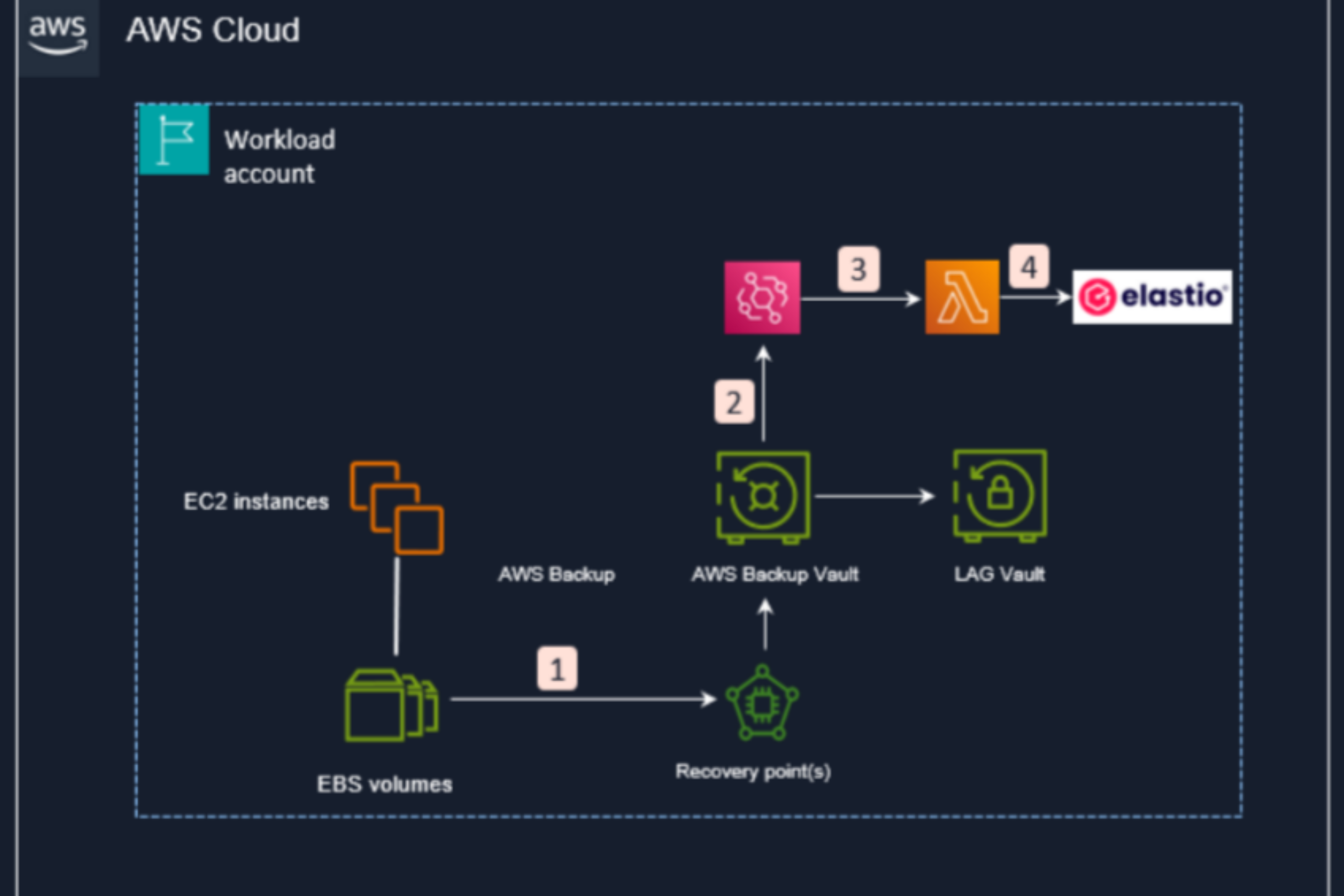
The Immutability Blind Spot AWS Logically Air-Gapped (LAG) Vaults are a massive leap forward for cloud recovery assurance. They provide the isolation and immutability enterprises need to survive catastrophic cyber events. But immutability has a dangerous blind spot: it doesn’t distinguish between clean data and corrupted data. If ransomware encrypts your production environment and those changes replicate to your backup snapshots before they are moved to the vault, you are simply locking the malware into your gold-standard recovery archive. You aren’t preserving your business; you’re preserving the attack. Today, Elastio has closed that gap. We introduced a new integration with AWS LAG that ensures only provably clean recovery points enter your immutable vault. By combining our deep-file inspection with a new Automated Quarantine Workflow, we prevent infected data from polluting your recovery environment. The Risk: "Immutable Garbage In, Immutable Garbage Out" The core principle of modern resilience is simple: Immutable storage isn't enough—data integrity must be proven. Ransomware attackers are evolving. They no longer just encrypt production data; they target backup catalogs and leverage "slow burn" encryption strategies to corrupt snapshots over weeks or months. Standard signature-based detection tools often miss these storage-layer attacks because they are looking for executable files, not the mathematical signs of entropy and corruption within the data blocks themselves. If you copy an infected recovery point into an AWS LAG Vault and lock it with a compliance retention policy, you create a restoration loop: every time you attempt to recover, you re-infect the environment. The Elastio Solution: Verify, Then Vault Elastio has updated its recovery assurance platform to act as that gatekeeper. We utilize machine learning-powered ransomware encryption detection models designed specifically to catch advanced strains, including slow encryption, striped encryption, and obfuscated patterns. Here is the new workflow for AWS LAG customers: Ingest & Inspection: As workload backups or snapshots are generated, Elastio automatically inspects the data for signs of ransomware encryption and corruption.The Decision Engine: Based on the inspection results, the workflow forks immediately:Path A: The Clean Path. If the data is verified as clean, it is routed to the customer’s Immutable LAG Vault. Once there, it undergoes automated recovery testing on a set schedule to prove recoverability.Path B: The Infection Path. If data is flagged as infected, it is blocked from entering the clean LAG vault. Instead, the compromised snapshot is automatically routed to a Quarantine Vault, which can itself be configured as a separate Logically Air-Gapped Vault. Optionally, Elastio can trigger the deletion of the local copy immediately after the move to either the clean or quarantine vault is complete, eliminating the need to maintain local retention. Why This Matters for the Enterprise For CISOs, Cloud Architects, and Governance teams, this workflow shifts the posture from "hopeful" to "provable." Audit-Ready Compliance: Whether you are dealing with NYDFS, HIPAA, or cyber insurance requirements, you can now prove that your immutable archives are free of compromise.Reduced Incident Response Time: By automatically segregating infected data, IR teams don't have to waste time shifting through thousands of snapshots to find a clean version. Elastio points you directly to the last clean copy and the first infected copy.Cost Control: You stop paying for premium, immutable storage on data that is useless for recovery. Real-World Value Elastio delivers outcome-driven security. With this update, we provide: Provable Recovery: You don’t just think your backups will work; you have a verified, clean report to prove it.Ransomware Impact Detection: Identify the exact moment of infection to minimize data loss (RPO).Integrity Assurance: Validate that no tampering has occurred within the data before it becomes immutable. Take Control of Your Recovery Don't let your backup vault become a ransomware repository. Ensure that every recovery point stored in AWS LAG is verified, validated, and clean. 3 Key Takeaways Immutability != Integrity Locking unverified data creates a "restoration loop" where ransomware is preserved alongside your critical assets.The "Verify-Then-Vault" Gatekeeper Elastio sits upstream of your AWS LAG Vault, inspecting every recovery point. Only verified clean data is allowed to enter your gold-standard archive, ensuring it remains uncompromised.Automated Quarantine Infected snapshots are instantly routed to a secure Quarantine Vault for forensic analysis, isolating threats without contaminating your clean recovery environment or slowing down response teams.