Elastio Software,  Ransomware,  Cyber Recovery

Introducing Elastio for Amazon FSx for NetApp ONTAP Filers

Author

Elastio Product Team

Date Published

An open bank vault door

AI-Ready & Ransomware-Proof FSx for NetApp ONTAP

Amazon FSx for NetApp ONTAP (FSxN) has become the gold standard for high-performance cloud storage, combining the agility of AWS with the data management power of NetApp.

Today, this infrastructure is more critical than ever. As unstructured data volumes explode and enterprises race to feed Generative AI models, FSxN has evolved into the engine room for innovation. It holds the massive datasets that fuel your AI insights and drive business logic.

You cannot build trusted AI on unverified data

FSxN delivers the trusted, high-performance platform your enterprise relies on. But true trust requires more than uptime—it requires integrity. As enterprise architectures evolve, so do the threats targeting them. The sheer scale of unstructured data creates a massive blind spot where ransomware can hide, silently corrupting data over weeks. If the data residing on your trusted storage is compromised, your AI models are being trained on poisoned assets.

The Imperative: Verified Data for Trusted AI

Today, Elastio is introducing comprehensive Ransomware Recovery Assurance for Amazon FSx for NetApp ONTAP. We now provide a layered defense that validates the integrity of the data within your primary volumes, SnapMirror replicas, and AWS Backups, ensuring that your storage is not just available, but provably clean.

The Three-Tier Defense for FSxN

To understand where Elastio fits, we must look at the modern FSxN protection architecture. A resilient implementation typically relies on three layers :
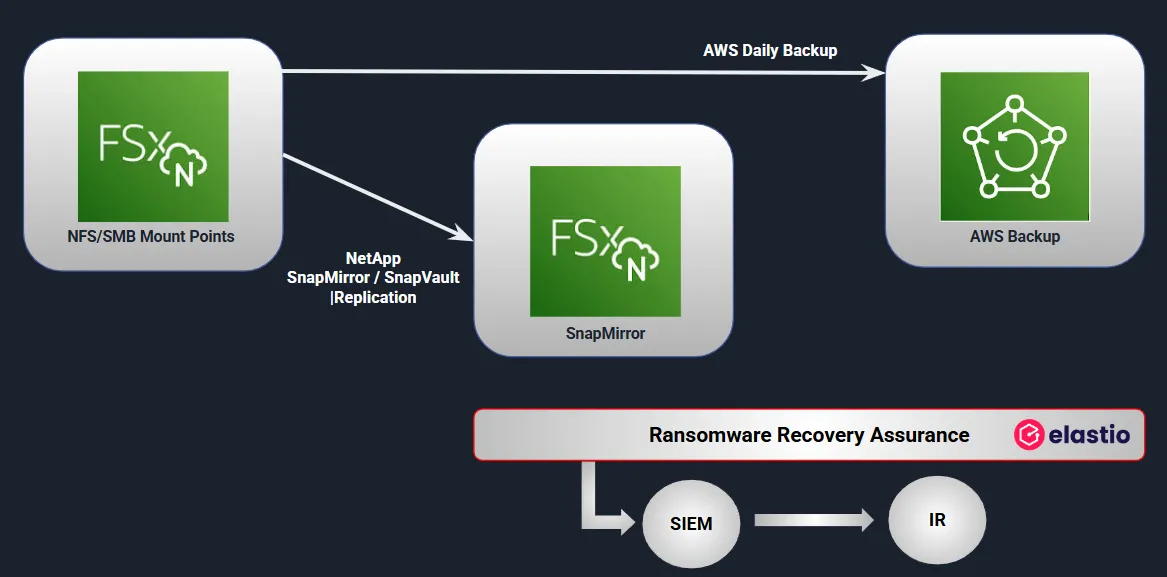
  1. Primary Filer: Your active, high-performance workload.
  2. SnapMirror Replica: A near-real-time, read-only copy used for disaster recovery with low RPOs (e.g., 5 minutes).
  3. AWS Backup: A daily recovery point for long-term retention and compliance.

Until now, verified recoverability across these layers was a blind spot. Elastio eliminates that uncertainty by integrating with the entire chain to validate data integrity before a crisis occurs.

The Risk of Silent Corruption

Ransomware attacks frequently begin subtly, bypassing perimeter defenses and modifying data blocks without triggering immediate alerts. If these corrupted blocks are replicated to your SnapMirror destination or archived into your AWS Backup vault, you aren't preserving your business—you are preserving the attack.

Just having backups is not enough. To ensure resilience, you must answer three questions about your recovery points :

  • Are they safe?
  • Are they intact?
  • Are they recoverable?

Introducing Elastio Recovery Assurance for FSxN

Elastio delivers agentless, automated verification for FSxN environments. Our platform connects to your infrastructure to perform deep-file inspection, providing :

  • Behavioral Ransomware Detection: We identify encryption patterns that signature-based tools miss, including slow-rolling and obfuscated encryption.
  • Insider Threat Detection: We detect malicious tampering or unauthorized encryption driven by compromised credentials.
  • Corruption Validation: We identify unexpected data corruption that could render a backup unusable during a restore.

This coverage spans the entire lifecycle. Elastio scans your SnapMirror replicas for immediate RPO validation and utilizes AWS Restore Testing to validate your AWS Backups without rehydrating production data.

Complementing NetApp’s Native Defenses

Elastio is designed to work with your existing security stack, not replace it.

NetApp’s native Autonomous Ransomware Protection (ARP) is an excellent first line of defense, monitoring your production environment for suspicious activity in real-time.

Elastio complements ARP by operating beyond the production path. We focus on the recovery chain, performing deep-dive analysis on your backups and replicas. If ARP flags a potential threat in production, Elastio allows you to instantly identify which historical recovery point is clean, verifiable, and safe to restore .

Compliance: From "Prevention" to "Proof"

Regulatory pressure is shifting. Frameworks like DORA, NYDFS, HIPAA, and PCI-DSS are moving away from simple backup retention mandates toward requirements for demonstrable recovery integrity.

Auditors and cyber insurers no longer accept "we have backups" as an answer. They require proof that those backups can be restored. Elastio automates this reporting, providing a validated inventory of clean snapshots that satisfies the most stringent compliance and risk requirements.

To achieve maximum resilience with FSxN, we recommend the following layered approach :

  1. Replicate: Use SnapMirror to maintain a secondary copy with a 5-minute RPO.
  2. Retain: Use AWS Backup to enforce retention policies.
  3. Validate:
    • Run Elastio Hourly Scans on SnapMirror replicas to catch infection early.
    • Run Elastio Restore Tests monthly on AWS Backups to verify your vault.

Conclusion

In the current threat landscape, ransomware is not a matter of if, but when.

Your data is only protected if it can be recovered. With Elastio’s new support for Amazon FSx for NetApp ONTAP, you can move beyond checking a backup box and gain true recovery assurance. In just minutes per TB, you will know if your data is clean or compromised, and be ready to recover with confidence.

3 Key Takeaways

  1. AI Integrity Requires Clean Data As FSxN drives generative AI and unstructured data growth, silent corruption becomes a critical risk. Elastio prevents "poisoned" datasets by detecting corruption inside the storage layer.
  2. End-to-End Validation Elastio secures the entire FSxN lifecycle, providing deep inspection and clean recovery verification for primary volumes, SnapMirror replicas, and AWS Backups.
  3. The "Production and Recovery" Defense Elastio operates outside the production path to complement NetApp’s Autonomous Ransomware Protection (ARP), validating snapshots to ensure you always have a safe place to restore from.
Recover With Certainty

See how Elastio validates every backup across clouds and platforms to recover faster, cut downtime by 90%, and achieve 25x ROI.

Related Articles
<img src="featured-image.jpg" alt="Cloud-native architecture ransomware risk and data integrity" />
Elastio Software,  Ransomware
February 7, 2026

Cloud-Native Architectures Shift Ransomware Risk to Data Integrity While cloud platforms improve availability and durability through replication, immutability, and automated recovery, they do not ensure data integrity. In cloud-native environments, compute is ephemeral and identity-driven, but persistent storage is long-lived and highly automated. This shifts ransomware risk away from servers and toward data itself. Modern ransomware increasingly exploits compromised cloud credentials and native APIs to encrypt or corrupt data gradually, often without triggering traditional malware detection. As a result, immutable backups and replicas can faithfully preserve corrupted data, leaving organizations unable to confidently restore clean systems. Ransomware resilience in cloud-native architectures therefore requires data integrity validation: continuous verification that backups, snapshots, and storage objects are clean, recoverable, and provably safe to restore. Without integrity assurance, recovery decisions depend on manual forensics, increasing downtime, operational risk, and regulatory exposure. Executive Strategic Assessment We have successfully re-architected our enterprise for the cloud, adopting a model where compute is ephemeral and infrastructure is code. In this environment, we no longer repair compromised servers; we terminate them. This success has created a dangerous blind spot. By making compute disposable, we have migrated our risk entirely to the persistent storage layer (S3, EBS, FSx, RDS). Our current architectural controls—S3 Versioning, Cross-Region Replication, and Backup Vault Locks—are designed for Durability and Availability. They guarantee that data exists and cannot be deleted. They do not guarantee that the data is clean. In cloud-native security, data integrity means the ability to cryptographically and behaviorally verify that stored data has not been silently encrypted, corrupted, or altered before it is used for recovery. In a modern ransomware attack, the threat is rarely that you "lose" your backups; it is that your automated, immutable systems perfectly preserve the corrupted state. If we replicate an encrypted database to a compliance-mode vault, we have not preserved the business—we have simply "vaulted the virus."Under the shared responsibility model, cloud providers protect the availability of the platform, while customers retain responsibility for ensuring the correctness and integrity of the data they store and recover. This brief analyzes the Integrity Gap in cloud-native resilience. It details the architectural controls required to transition from assuming a clean recovery to algorithmically proving it, ensuring that when the Board asks, The New Risk Reality: Ephemeral Compute, Permanent Risk Our migration to cloud-native architectures on AWS has fundamentally shifted our risk profile. We have moved from "repairing servers" to "replacing them." Compute is now disposable (containers, serverless functions, auto-scaling groups) and identity is dynamic (short-lived IAM credentials). This is a security win for the compute layer because the "crime scene" effectively evaporates during an incident. Cloud changes where risk concentrates, not whether risk exists. Recent incident analysis shows stolen credentials as a leading initial access vector, with median attacker dwell time measured in days rather than months. This compression of time is what enables low-and-slow data corruption to outrun human-driven validation. Multiple industry investigations support this pattern, including Mandiant and Verizon DBIR reporting that credential abuse and identity compromise are now among the most common initial access vectors in cloud environments, with attackers often persisting long enough to corrupt data before detection. However, this architecture forces a massive migration of risk into the persistent storage layer. Modern ransomware attacks exploit this shift by targeting the integrity of the state itself. Attackers encrypt object stores, poison transaction logs, or utilize automation roles to mass-modify snapshots.Why aren’t cloud-native architectures inherently ransomware-safe? Because cloud controls prioritize availability and automation, not verification of data correctness at restore time. The Strategic Blind Spot: Immutability is Not Integrity Our current resilience strategy aligns with AWS Well-Architected frameworks. We rely heavily on Availability and Durability. We use S3 Versioning, AWS Backup Vault Locks, and Cross-Region Replication. These controls are excellent at ensuring data exists and cannot be deleted. However, they fail to ensure the data is clean. Integrity controls verify recoverability and correctness of restoration assets, not just retention. Operationally, this means validating data for encryption or corruption, proving restore usability, and recording a deterministic “last known clean” recovery point so restoration decisions do not depend on manual forensics. In a "Low and Slow" corruption attack, a threat actor uses valid, compromised credentials to overwrite data or generate new encrypted versions over weeks. In cloud environments, attackers increasingly encrypt or replace data using native storage APIs rather than custom malware. Once access is obtained, legitimate encryption and snapshot mechanisms can be abused to corrupt data while appearing operationally normal.This creates a failure mode unique to cloud-native architectures: attacks can succeed without malware, without infrastructure compromise, and without violating immutability controls. The "Immutable Poison" Problem: If an attacker encrypts a production database, Backups will dutifully snapshot that corruption. If Vault Lock is enabled, we effectively seal the corrupted state in a compliance-mode vault. We have preserved the attack rather than the business. Vault Locking prevents deletion and lifecycle modification of recovery points, including by privileged users. It does not validate the integrity or cleanliness of the data being ingested and retained.Replication Accelerates Blast Radius: Because replication is designed for speed (RPO), it immediately propagates the corrupted state to the DR region. The Missing Control: Recovery Assurance During a ransomware event, the most expensive resource is decision time. The Board will not ask "Do we have backups?" They will ask "Which recovery point is the last known good state?" Without a dedicated integrity control, answering this requires manual forensics. Teams must mount snapshots one by one, scan logs, and attempt trial-and-error restores. This process turns a 4-hour RTO into a multi-day forensic ordeal. Industry data shows that organizations take months to fully identify and contain breaches, and multi-environment incidents extend that timeline further. This gap is why recovery cannot depend on snapshot-by-snapshot investigation during an active crisis. Critically, integrity validation produces durable evidence, timestamps, scan results, and clean-point attestations that can be reviewed by executives, auditors, and regulators as part of post-incident assurance. Where Elastio Fits: The Integrity Assurance Layer Elastio fits into our architecture not as a backup tool, but as an Integrity Assurance Control (NIST CSF "Recover") that audits the quality of our persistence layer. Detection in Depth: Unlike EDR which monitors processes, Elastio watches the entropy and structure of the data itself. It scans S3 buckets and EBS snapshots for the mathematical signatures of encryption and corruption.Provable Recovery: Elastio indexes recovery points to algorithmically identify the "Last Known Clean" timestamp. This allows us to automate the selection of a clean restore point and decouple recovery time from forensic complexity. Platform Engineering Guide Architecture Context Elastio operates as an agentless sidecar. It utilizes scale-out worker fleets to mount and inspect storage via standard Cloud APIs (EBS Direct APIs, S3 GetObject, Azure APIs). It does not require modifying production workloads or installing agents on production nodes. Protection Capabilities by Asset Class 1. AWS S3 & Azure Blob Data Lakes Real-Time Inspection: The system scans objects in real-time as they are created. This ensures immediate detection of "infection by addition."Threat Hunting: If threats are found, automated threat hunts are performed on the existing objects/versions to identify the extent of the compromise.Recovery: The system identifies the last known clean version, allowing restores to be automated and precise. 2. Block Storage (EBS, EC2, Azure Disks, Azure VMs) Scale-Out Scanning: Automated scans of persistent storage are performed using ephemeral, scale-out clusters. This ensures that inspection does not impact the performance of the production workload.Policy Control: For long-lived workloads (e.g., self-hosted databases), policies control how frequently to scan (e.g., daily, hourly, or on snapshot creation) to balance assurance with cost. Integrity validation frequency must be faster than plausible time-to-impact. With ransomware dwell time measured in days, weekly validation leaves material integrity gaps. For critical, high-risk workloads, production data validation can be configured to run as frequently as hourly, based on policy and business criticality, while lower-risk assets can operate at longer intervals to balance assurance, cost, and operational impact. 3. AWS Backup Scan-on-Create: Automated scanning of backups occurs immediately as they are created.Asset Support: Supports EC2, EBS, AMI, EFS, FSx, and S3 backup types.Vault Integration: Fully integrated with AWS Backup Restore Testing and Logically Air-Gapped (LAG) Vaults, ensuring that data moving into high-security vaults is verified clean before locking. 4. Azure Backup Scan-on-Create: Automated scanning of backups occurs immediately as they are created.Asset Support: Supports Azure VM, Azure Managed Disks, and Azure Blobs. 5. Managed Databases (RDS / Azure Managed SQL) Status: Not Supported.Note: Direct integrity scanning inside managed database PaaS services is not currently supported. Table 1: Threat Manifestation & Control Fit Architecture ComponentThe "Native" Failure ModeProtection Available (Elastio)AWS S3 / Azure Blob"Infection by Addition"Ransomware writes new encrypted versions of objects. The bucket grows, and "current" versions are unusable.Real-Time Detection & HuntingScans real-time as objects are created. Automates threat hunts for last known clean versions. Automates restores.EC2 / Azure VMs(Self-Hosted DBs)The "Live Database" AttackAttackers encrypt database files (.mdf, .dbf) while the OS remains up. Standard snapshots capture the encrypted state.Automated Integrity ScansAutomated scans of persistent storage in scale-out clusters. Policies control scan frequency for long-lived workloads.AWS BackupVault PoisoningWe lock a backup that was already compromised (Time-to-detect > Backup Frequency).Scan-on-Create (Vault Gate)Automated scanning of backups (EC2, EBS, AMI, EFS, FSx, S3) as they are created. Integrated with AWS Restore Test and LAG Vaults.Azure BackupReplica CorruptionBackup vaults replicate corrupted recovery points to paired regions.Scan-on-CreateAutomated scanning of Azure VM, Managed Disk, and Blob backups as they are created.Managed DBs(RDS / Azure Managed SQL)Logical CorruptionValid SQL commands drop tables or scramble columns.Not SupportedIn these environments, integrity assurance must be addressed through complementary controls such as transaction log analysis, application-layer validation, and point-in-time recovery testing. Conclusion Adopting this control moves us from a posture of "We assume our immutable backups are valid" to "We have algorithmic proof of which recovery points are clean." In an era of compromised identities, this verification is the requisite check-and-balance for cloud storage. This control removes uncertainty from recovery decisions when time, trust, and data integrity matter most.In cloud-native environments, ransomware resilience is no longer defined by whether data exists, but by whether its integrity can be continuously proven before recovery.In practical terms, any cloud-native ransomware recovery strategy that cannot deterministically identify a last known clean recovery point before restoration should be considered operationally incomplete. This perspective reflects patterns we consistently see in enterprise incident response, including insights shared by Elastio advisors with deep experience leading ransomware investigations and cloud recovery efforts.

Elastio Software,  Ransomware
February 1, 2026

Elastio and AWS recently hosted a joint webinar, “Modern Ransomware Targets Recovery: Here’s What You Can Do to Stay Safe.” The session brought together experts to unpack how ransomware tactics are evolving and what organizations need to do differently to stay resilient. A clear theme emerged. Attackers are no longer focused on disruption alone. They are deliberately sabotaging recovery. Ransomware Has Shifted From Disruption to Recovery Sabotage Modern ransomware no longer relies on fast, obvious encryption of production systems. Instead, attackers often gain access months in advance. They quietly study the environment, including backup architectures, replication paths, and retention windows. Encryption happens slowly and deliberately, staying below detection thresholds while corrupted data propagates into snapshots, replicas, and backups. By the time the attack is triggered and ransom is demanded, recovery options are already compromised. This represents a fundamental shift in risk. Backups are no longer just a safety net. They are a primary target. Ransomware Risk Is Unquantifiable Without Proven Clean Recovery Points Ransomware risk becomes impossible to quantify when organizations cannot prove their recovery data is clean. Boards, regulators, and insurers are no longer reassured by the mere existence of backups. They want to know how quickly recovery can happen, which recovery point will be used, and how its integrity is verified. Most organizations cannot answer these questions with confidence because backup validation is not continuous. The consequences are real. Extended downtime, board-level exposure, insurance gaps, and growing regulatory pressure under frameworks such as DORA, NYDFS, and PRA. Without proven clean recovery points, ransomware becomes an unbounded business risk rather than a technical one. The Three Pillars of Ransomware Recovery Assurance The webinar emphasized that real ransomware resilience depends on three pillars working together. Immutability and isolation ensure backups are tamper-proof and stored separately, protected by independent encryption keys. AWS capabilities such as logically air-gapped vaults support this foundation.Availability focuses on whether recovery can happen fast enough to meet business expectations, particularly when identity systems are compromised. Clean-account restores and multi-party approval become critical.Integrity, the most overlooked pillar, ensures backups are continuously validated to detect encryption, corruption, malware, and fileless attacks, and to clearly identify the last known clean recovery point. If any pillar fails, recovery fails. For more information: Resilience by design: Building an effective ransomware recovery strategy | AWS Storage Blog Malware Scanning Is Not Ransomware Detection The speakers drew a clear distinction between traditional malware scanning and what is required to defend against modern ransomware. Signature-based tools look for known binaries, but today’s attacks often run in memory, use polymorphic techniques, and encrypt data without leaving a detectable payload. In these cases, the absence of malware does not mean the absence of damage. Effective ransomware defense requires detecting the impact on data itself, including encryption, corruption, and abnormal change patterns, not just the presence of malicious code. Validation Enables Faster, Safer Recovery Without Paying Ransom A real-world case study illustrated the value of recovery validation. Attackers encrypted data gradually over several days, allowing compromised data to flow into backups that appeared intact but were unsafe to restore. Through targeted threat hunting, Elastio identified a clean recovery point from roughly six days earlier, enabling the company to restore operations without paying the ransom. With downtime costs often reaching millions per day, even small reductions in recovery time have outsized financial impact. The takeaway was simple. Knowing where to recover from matters more than recovering quickly from the wrong place. Key Takeaways Ransomware now targets recovery, not just production.Attackers gain access early, encrypt data slowly, and ensure corruption spreads into replicas and backups before triggering an attack. By the time ransom is demanded, recovery paths are often already compromised.Backups alone are not proof of recoverability.Without continuous validation, organizations cannot confidently identify a clean recovery point, making ransomware risk impossible to quantify.True ransomware resilience depends on three pillars.Immutability and isolation protect backups from tampering, availability ensures recovery meets business expectations, and integrity validation confirms recovery data is usable. If integrity fails, recovery fails.Malware detection is not ransomware detection.Fileless and polymorphic attacks often evade signature-based tools. Detecting the impact on data, such as encryption and corruption, is critical.Provable recovery changes the economics of ransomware.Validated recovery points reduce downtime, avoid reinfection, and can eliminate the need to pay ransom, delivering measurable operational and financial impact. Additional Resources AWS ReInvent: How Motability Operations built a ransomware-ready backup strategy with AWS Backup & Elastio AWS re:Invent 2025 - Motability Operations' unified backup strategy: From fragmented to fortified

Elastio Software
January 22, 2026

In early 2026, U.S. authorities issued a cyber threat alert warning organizations about evolving tactics used by North Korean state-sponsored cyber actors. The advisory highlights how the Democratic People’s Republic of Korea (DPRK) continues to refine its cyber operations to conduct espionage, gain persistent access to networks, and generate revenue to support state objectives. This activity underscores a broader reality: DPRK cyber operations are no longer niche or experimental. They are mature, adaptive, and increasingly effective against both public- and private-sector targets. Evolving Tradecraft: From Phishing to QR Code Attacks A key focus of the alert is the growing use of malicious QR codes embedded in phishing emails, a technique often referred to as “quishing.” Instead of directing victims to malicious links, attackers embed QR codes that prompt users to scan them with mobile devices. This approach allows attackers to bypass traditional email security controls and exploit weaker defenses on mobile platforms. Once scanned, these QR codes redirect victims to attacker-controlled pages that closely mimic legitimate login portals, such as enterprise email or remote access services. Victims who enter their credentials unknowingly hand over access to their accounts, enabling attackers to move laterally, conduct follow-on phishing campaigns, or establish long-term persistence. Kimsuky and Targeted Espionage The activity described in the alert is attributed to a DPRK-linked cyber group commonly referred to as Kimsuky. This group has a long history of targeting policy experts, think tanks, academic institutions, and government entities, particularly those involved in foreign policy and national security issues related to the Korean Peninsula. What distinguishes recent campaigns is the subtlety of the lures and the deliberate exploitation of user trust. Emails are crafted to appear routine or administrative, and QR codes are presented as harmless conveniences. This increases the likelihood of successful compromise, even in security-aware environments. Cybercrime as Statecraft DPRK cyber operations should not be viewed solely through the lens of traditional espionage. North Korea has repeatedly demonstrated its willingness to use cybercrime as a strategic tool. In parallel with intelligence collection, DPRK-linked actors have conducted financially motivated attacks, including cryptocurrency theft, financial fraud, and illicit remote employment schemes. These activities serve a dual purpose: generating revenue to circumvent international sanctions and providing operational cover for broader intelligence objectives. In many cases, what appears to be simple fraud is ultimately tied to state-directed priorities. Why This Matters Now The techniques outlined in the 2026 alert highlight how DPRK cyber actors are adapting faster than many defensive programs. By shifting attacks to mobile devices, exploiting human behavior, and blending espionage with financial crime, they reduce the effectiveness of traditional security controls. For organizations, this means that technical defenses alone are no longer sufficient. User awareness, mobile security posture, identity protection, and anomaly detection all play a critical role in mitigating risk. Key Takeaways for Organizations Organizations should assume that DPRK cyber activity will continue to evolve and expand in scope. Practical steps include updating security awareness training to address QR code–based attacks, monitoring for anomalous authentication behavior, limiting credential reuse, and treating identity compromise as a high-impact security incident. Most importantly, leaders should recognize that DPRK cyber operations are persistent, well-resourced, and strategically motivated. Understanding this threat is essential not only for government and policy organizations, but for any enterprise operating in an increasingly interconnected and geopolitically influenced digital environment.