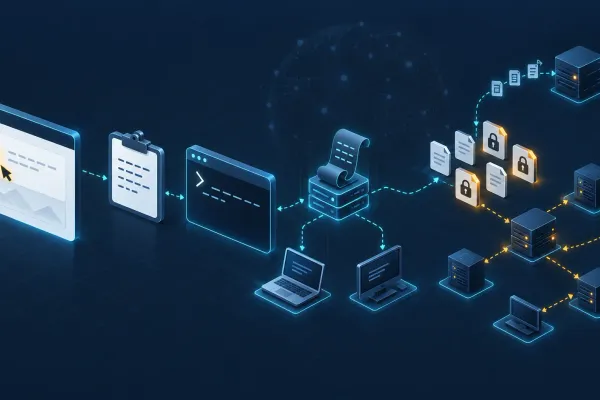
The Blind Spot Undermining Zero Trust and How Data Resilience Closes the Gap
Zero Trust has become the operating doctrine of modern cybersecurity. Every user, device, and request must be authenticated, authorized, and continuously verified. Yet one category has quietly slipped out of the spotlight: machine-generated identities. These are non-human actors created automatically inside cloud and DevOps environments. They orchestrate microservices, move data between layers, trigger automation pipelines, and run autonomous workloads at massive scale.
Enterprises often have tens of thousands of these identities operating simultaneously. They are created instantly, granted permissions programmatically, perform sensitive actions by design, and then disappear minutes or hours later. Traditional identity governance, monitoring, and behavior analytics are poorly equipped to track them.
This blind spot now represents one of the most significant and least understood risks in modern cloud security.
What changed
A few years ago, most enterprise identities represented people. Even service accounts typically mapped to long-lived hosts or well-understood roles. Today, a single cloud application can generate hundreds or thousands of ephemeral identities each day. Containers spin up, run a process, touch sensitive data, write to logs, make API calls, and then vanish. Serverless workloads generate identities for the duration of one function execution. CI systems create short-lived tokens that download source, push artifacts, and modify infrastructure.
These identities have no inbox, no phone, and no human behavior pattern. They cannot use multi-factor authentication. They often hold elevated privileges because the default configuration for automation is convenience. And because lifecycle management is automated, they rarely appear in audit discussions until something has already gone wrong.
Why attackers care
For adversaries, this represents a perfect opportunity. Compromise no longer requires phishing a human being or bypassing endpoint security. Instead, they target a workload identity that exists only inside cloud automation. If that identity carries permissions to read object stores, launch instances, modify data, or request snapshots, an attacker inherits all of those capabilities instantly.
Even more concerning, compromised machine identities blend seamlessly into normal operations. Their activity patterns are noisy, unpredictable, and highly variable. What looks like suspicious behavior from a human rarely looks suspicious from an automated process. This makes detection extraordinarily difficult.
In this new threat model, attackers do not need persistence on a host. The identity itself is the persistence.
The consequence of zero trust
Zero Trust assumes that every request is robustly verified. But what happens when the requester is an ephemeral identity with no behavioral baseline, no user context, and essentially no ability to be challenged?
The answer is simple. Zero Trust begins to break down.
Identity is supposed to be the new perimeter. But machine identities operate outside the visibility of conventional identity governance. They change too quickly for manual oversight, they hold too many permissions for comfort, and they continuously interact with critical data paths.
Enterprises must begin treating machine identities not as technical abstractions but as a primary security domain.
The data layer is where the risk becomes real
Machine identities do not steal credentials, escalate privileges, or exfiltrate information in the same way human adversaries do. Their impact is most visible in the data itself.
This includes unauthorized reads of sensitive objects, modification of datasets, corruption of critical backups, injection of malicious content into pipelines, or the manipulation of metadata that governs data access and retention.
Once data is changed, the downstream consequences propagate rapidly. Replication jobs copy the corrupted state. Analytics systems import compromised inputs. Backup systems preserve tainted versions.
If machine identity misuse is not detected at the data layer, organizations may lose the ability to trust any copy of their environment.
Identity management can fail. Permissions can drift. Automation pipelines can be hijacked. Developers can unintentionally create exposure through misconfigured roles. And adversaries can weaponize machine identities that every legacy control.
What cannot fail is the integrity of the data that an organization relies upon to recover.
CISOs are now recognizing that resilience is not simply about backup storage or snapshot retention. It is about guaranteeing that what you recover is trustworthy. It is about detecting identity misuse, not only by observing behavior, but by validating the safety and correctness of the data that those identities touch.
Machine identity threats cannot always be contained at the identity layer. They must be caught at the data layer.
As enterprises accelerate automation, the number of non-human identities will grow exponentially. This shift demands a new understanding of identity risk and a new appreciation for the role of data integrity in overall security posture. Zero Trust is essential. But without verifiable trust in the data itself, Zero Trust is incomplete.
This is the gap Elastio is built to close.
3 Key Takeaways
- Machine identities are a growing Zero-Trust blind spot
- Attackers exploit ephemeral automation identities undetected
- Data-layer validation is critical for resilience